Temperature Effects on Fatigue of Thermoset and Thermoplastic Composites

A professional analysis of how temperature influences the static and fatigue performance of thermoset and thermoplastic composites, and what it means for compression mold.

As industries push toward lightweight, high-efficiency, and long-duration structures, the mechanical performance of thermoset composites and thermoplastic composites under extreme environmental conditions has become a critical research topic. Applications in aerospaceautomotivenew energy, and industrial machinery demand composite materials that maintain high stiffness, strength, and fatigue resistance across large temperature variations.

In a recent study, researchers evaluated one commercial thermoset material and two high-performance thermoplastic composites in the temperature range of −30°C to +120°C. These conditions simulate real operating environments such as winter cold starts, under-hood temperatures in vehicles, and heating cycles found in industrial systems. The research provides new insights highly relevant to manufacturers of composite toolingcompression molds, and high-temperature composite components.

1. Static Mechanical Performance: Thermoset vs. Thermoplastic Composites

Tensile tests performed across the full temperature range reveal clear differences in the static behavior between thermoset and thermoplastic materials. The evaluated thermoset composite maintains a relatively stable modulus and tensile strength even as temperature approaches +120°C, confirming its suitability for high-temperature composite mold applications and structural components in automotive environments.

In contrast, the two thermoplastic composites exhibit more significant variations in stiffness and elongation. Their temperature-dependent viscoelastic behavior leads to reduced modulus at high temperatures but improved impact performance at low temperatures. This duality makes them ideal for parts manufactured through compression molding, especially components requiring energy absorption.
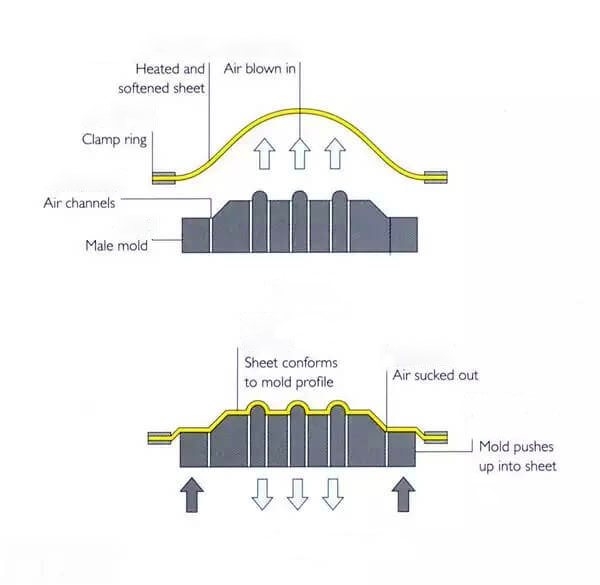
thermoforming

2. Fatigue Behavior Under Extreme Temperatures

The fatigue test results highlight temperature as a dominant factor in long-term structural reliability. At elevated temperatures, polymers undergo chain mobility changes and microstructural relaxation, accelerating fatigue damage. The thermoplastic materials show greater sensitivity to this effect, while the thermoset composite demonstrates superior high-temperature fatigue resistance due to its highly cross-linked network.

This is particularly important for manufacturers of compression-molded composite parts, including:

  • Automotive underbody protection systems
  • EV battery structural housings
  • Engine compartment covers
  • High-load brackets and cross-car beams
  • Industrial pump and motor components

MDC’s expertise in SMC moldBMC moldcarbon fiber mold, and thermoplastic composite mold development ensures reliable processing for these demanding applications.

3. Implications for Composite Mold and Compression Molding Production

Understanding the temperature-dependent fatigue behavior is essential not only for material selection but also for designing advanced composite moulds and compression tooling. Mold temperature control, heating uniformity, and optimized venting must all be aligned with the specific thermal response of the material.

For example:

  • Thermoset composites (e.g., SMC, BMC) require precise temperature control (135–160°C) to ensure full curing.
  • Thermoplastic composites (e.g., LFT, CF-reinforced PP) need rapid heating & cooling cycles to maintain consistency.
  • Carbon-fiber hybrid composites demand stable mold rigidity and low thermal distortion for aerospace-grade accuracy.

These factors directly influence mold lifespan, cycle time, and part repeatability—areas where MDC Mould has extensive industrial experience.

4. Research Funding and Industrial Context

This study is partially funded by the Italian Ministry of Enterprises and Made in Italy (MIMIT) under the project: “New Generation of Modular Intelligent Oleo-dynamic Pumps with Axial Flux Electric Motors.” The research aligns strongly with global industry trends in improving thermal stability and mechanical reliability of composite components used in motors, pumps, automotive assemblies, and energy systems.

Conclusion

The investigation into the temperature-dependent fatigue performance of thermoset and thermoplastic composites provides critical insights for high-precision composite manufacturing. As the automotive and energy industries transition toward lightweight structures, the demand for temperature-resistant, high-fatigue-strength materials will continue to rise.

With advanced technical capability in SMC moldsBMC moldscarbon fiber moldsthermoplastic composite molds, and large-format composite toolingMDC Mould is positioned to support global customers developing next-generation high-performance composite parts.
Advancements and Future Trends of Composite Materials in Commercial Aviation

Explore the latest advancements in composite materials for civil aviation, including liquid molding, thermoplastic composites, green technologies, and prepreg innovations.

In recent years, the emergence of new materials and advanced manufacturing processes has accelerated the development of composite materials toward higher performance, greater efficiency, lower cost, and improved sustainability. This trend is driving the application of composites in commercial aircraft to new levels, making them a critical benchmark in evaluating the advancement of next-generation civil aviation programs.

Today, composite usage in major aircraft models continues to climb. The Airbus A350 features composites in 53% of its structural weight, while the Boeing 787 Dreamliner incorporates 50%. China’s domestically developed wide-body aircraft is also expected to achieve a similar level. Aircraft fuselages, wings, and secondary load-bearing components increasingly rely on composites. Over 90% of these parts are produced using autoclave molding processes, with epoxy-based carbon fiber prepregs as the primary material. Airbus plans to raise A350 output to 12 per month by 2028, while Boeing has reached up to 13 B787 units per month in past production cycles.

Growth of Liquid Molding Technologies

Beyond autoclave technology, liquid molding processes are advancing rapidly. Europe, the U.S., and Russia have all invested heavily in alternatives such as Resin Transfer Molding (RTM) and Vacuum Assisted Resin Infusion (VARI). These techniques are now the leading non-autoclave processes for resin-based composites and have expanded from secondary to primary load-bearing structures. Their advantages include lower production costs, scalability, and the potential for batch manufacturing of large aerospace components.

Advances in Thermoplastic Composites

Thermoplastic composites have achieved remarkable progress in recent years. Compared to thermoset composites, thermoplastic systems offer greater toughness, better flame resistance, and compatibility with various non-autoclave manufacturing methods. They deliver shorter cycle timesreduced costs, and higher efficiency. Initiatives such as the EU’s Clean Sky and NASA’s HiCAM (High-Rate Composite Aircraft Manufacturing) program highlight thermoplastics as a strategic research priority, making this one of the fastest-growing areas in aerospace composites.

composite mold

Green and Sustainable Composite Technologies

With rising use of composites, the industry faces challenges in recycling and sustainability. Emerging green composite technologies aim to mitigate these impacts through biodegradable polymers and eco-friendly matrix materials. Though currently in the R&D stage, these solutions will play a vital role in achieving long-term sustainability in aerospace manufacturing.

High-Performance Prepreg Innovations

Another area of advancement is the development of high-performance prepregs. Companies like Hexcel (IM10 carbon fiber) and Toray (T1100/3960 prepreg system) have launched materials with superior strength and stiffness. Toray’s TC1130 thermoplastic prepreg also solves the problem of low bonding strength, expanding the potential of thermoplastic composites in critical aerospace structures.

Future Outlook

The history of commercial aviation demonstrates that composite technology has continually advanced with each new generation of aircraft. In the future, adoption levels will rise further, particularly in areas such as:

  • Liquid molding for cost-efficient, large-scale production
  • Thermoplastic composites with enhanced toughness and flexibility
  • Green, recyclable materials for sustainability
  • Next-generation prepregs with improved performance

For China’s aviation industry, increasing R&D investment and strategic planning are essential. By fostering innovation in these directions, domestic manufacturers will ensure that future commercial aircraft composites remain competitive on a global scale while meeting both performance and sustainability objectives.

At Zhejiang MDC Mould Co., Ltd. (MDC), we are dedicated to advancing mold and tooling technologies for the aerospace sector. Our expertise covers SMC moldsBMC moldscompression moldscarbon fiber molds, and advanced composite tooling. By leveraging precision engineering, innovation, and sustainability, MDC continues to support the aerospace industry’s transition to a high-performance, cost-effective, and greener future.