GMT Molding in Automotive Lightweighting: High-Speed Tooling Solutions

Accelerate high-volume automotive production with premium GMT molds by MDC. Optimize underbody shields and crash structures via high-speed compression tooling.

As global industries accelerate toward electrification, lightweight engineering, sustainability, and high-volume manufacturing, composite materials are playing an increasingly important role in modern product development. Among various composite technologies, Glass Mat Thermoplastics (GMT) have emerged as a highly attractive solution for manufacturing large structural components that require an optimal balance of strength, weight reduction, durability, and production efficiency.

For automotive manufacturers, energy storage system suppliers, commercial vehicle producers, and transportation equipment manufacturers, GMT technology is no longer viewed as a niche material solution. Instead, it is becoming a strategic manufacturing platform capable of replacing traditional metal assemblies with lightweight integrated composite structures.

Behind this growing adoption lies continuous innovation in GMT moldGMT mouldGMT tooling, and advanced GMT molding technologies. Modern compression molding systems are enabling manufacturers to produce increasingly complex thermoplastic composite components while maintaining the productivity levels required for mass production.

The Shift Toward Large Integrated Composite Structures

For decades, automotive and industrial products were designed around metal fabrication technologies. Complex structures often consisted of numerous stamped components connected through welding, riveting, or mechanical fastening processes.

While effective, this manufacturing approach presents several challenges:

  • High component counts
  • Complex assembly operations
  • Increased manufacturing costs
  • Additional weight
  • Greater supply chain complexity
  • Longer production cycles

As manufacturers pursue greater efficiency, the industry is increasingly moving toward large integrated structures that combine multiple functions into a single molded component.

Examples include:

  • Battery enclosure covers
  • Battery protection shields
  • Vehicle underbody panels
  • Front-end carrier systems
  • Load floors
  • Commercial vehicle roof structures
  • Trunk modules
  • Energy storage equipment housings

These applications are creating new opportunities for advanced GMT tool development and large-scale thermoplastic composite manufacturing.
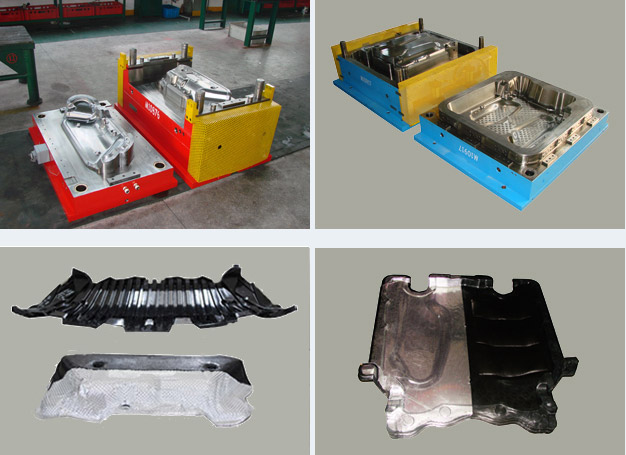
gmt mold

Why GMT Is Attracting Attention Across Multiple Industries

GMT combines glass fiber reinforcement with thermoplastic resin systems to create a composite material that offers excellent mechanical performance while supporting high-volume manufacturing.

Unlike many traditional materials, GMT provides a unique combination of:

  • Lightweight performance
  • High impact resistance
  • Excellent energy absorption
  • Corrosion resistance
  • Design flexibility
  • Fast production cycles
  • Recyclability

This combination makes GMT particularly attractive for industries where lightweight structures and production efficiency are equally important.

GMT vs Traditional Material Solutions

When selecting materials for large structural components, engineers typically compare GMT against steel, aluminum, and thermoset composites such as SMC.

PropertyGMTSMCSteelAluminum
Weight ReductionExcellentExcellentLimitedGood
Impact ResistanceExcellentGoodExcellentModerate
Corrosion ResistanceExcellentExcellentRequires ProtectionGood
Cycle TimeVery FastModerateFastFast
RecyclabilityExcellentLimitedExcellentExcellent
Part Integration PotentialHighHighLimitedLimited

These advantages explain why GMT molding is becoming increasingly important for next-generation vehicle platforms and industrial equipment.

Ultra-Short Cycle Times: Why GMT Molding Fits Automotive Mass Production

One of the most significant advantages of GMT molding compared with traditional thermoset composite technologies is production speed.

Unlike SMC compression molding, which relies on thermoset resin cross-linking and curing reactions that often require several minutes per cycle, GMT materials are based on thermoplastic matrices. The GMT charge is preheated externally and transferred directly into the compression mold, where it is formed and cooled under pressure.

Because no chemical curing reaction is required, cycle times can be dramatically reduced.

For automotive OEMs, manufacturing efficiency is measured in seconds. Large structural components such as battery covers, underbody shields, front-end carriers, and load floors must be produced at production rates compatible with highly automated vehicle assembly lines.

At MDC, advanced GMT mold and GMT tooling solutions are engineered specifically for high-volume manufacturing environments. Through optimized thermal management systems, rapid mold actuation technologies, efficient material loading strategies, and automation-ready tooling architectures, large thermoplastic composite structures can often achieve production cycles below 60 seconds.

This capability allows GMT molding to bridge the gap between traditional metal stamping and advanced composite manufacturing, making lightweight composite structures economically viable for mass-market vehicle production.

Superior Energy Absorption and Impact Resistance Through Fiber Network Integrity

As electric vehicles continue to evolve, lightweight structures must also provide exceptional impact resistance and durability.

One of the most important advantages of GMT materials is the retention of a continuous glass fiber mat network throughout the molding process. Unlike short-fiber reinforced plastics, GMT maintains a three-dimensional reinforcement architecture that significantly improves toughness and energy absorption.

This unique fiber network allows GMT components to absorb impact energy efficiently while resisting crack propagation and penetration damage.

Applications that benefit from these characteristics include:

  • Battery protection covers
  • Vehicle underbody shields
  • Front-end carrier systems
  • Commercial vehicle protection panels
  • Energy storage equipment housings

However, achieving these performance levels depends heavily on tooling design.

At MDC, advanced cavity engineering focuses on maintaining fiber network integrity throughout the compression molding process. Through precise cavity clearance management, optimized charge placement strategies, and controlled material flow paths, fiber breakage and excessive fiber accumulation can be minimized.

The result is a more uniform composite structure with superior resistance to stone impact, road debris strikes, underbody abrasion, and demanding service conditions.
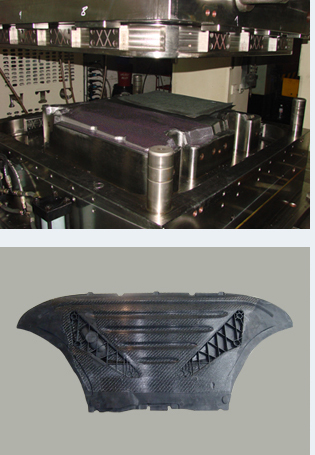
gmt mold

Zoned Mold Cooling Technology: Solving the Warpage Challenge of Large GMT Components

As GMT components become larger and more structurally complex, thermal management has become one of the most critical aspects of successful mold design.

Unlike thermoset composites, thermoplastic materials begin cooling and crystallizing immediately after compression. If cooling rates vary significantly across different areas of the mold, residual stresses can develop within the component.

These stresses often lead to:

  • Part warpage
  • Dimensional instability
  • Assembly difficulties
  • Surface distortion
  • Reduced long-term performance

For large automotive structures measuring over one meter in length, these challenges become particularly significant.

To address this issue, MDC incorporates advanced Zoned Cooling Systems into large-scale GMT tooling platforms.

By independently controlling temperatures across multiple mold regions and optimizing cooling channel layouts, heat extraction can be balanced throughout the molding cycle.

For highly complex geometries, MDC also applies engineering principles inspired by conformal cooling technology, enabling more uniform thermal conditions across critical molding surfaces.

The result is:

  • Reduced residual stress
  • Improved dimensional stability
  • Higher production consistency
  • Faster cycle times
  • Enhanced geometric accuracy

This technology helps manufacturers meet the stringent dimensional tolerance requirements demanded by modern automotive OEMs.

The Growing Role of GMT in Electric Vehicle Platforms

Electric vehicles have fundamentally changed the way automotive structures are designed.

Battery systems require large protective structures that must be lightweight, durable, electrically insulating, and cost-effective.

GMT molding offers an attractive solution for producing:

  • Battery pack covers
  • Battery protection shields
  • Underbody protection systems
  • Front-end modules
  • Structural reinforcement components

Through advanced compression molding processes, multiple metal parts can often be consolidated into a single integrated GMT component, reducing both weight and assembly complexity.

Expanding Applications Beyond Automotive

Although automotive manufacturing remains the primary market for GMT molding, adoption is expanding rapidly across multiple industries.

Energy Storage Systems

Large-scale energy storage projects require corrosion-resistant and lightweight housing structures. GMT components provide excellent durability while reducing overall system weight.

Commercial Vehicles

Electric trucks and buses benefit from GMT’s ability to deliver lightweight performance without sacrificing impact resistance.

Rail Transportation

Rail manufacturers increasingly use thermoplastic composites for interior panels, equipment housings, and structural assemblies.

Construction and Industrial Equipment

Heavy equipment manufacturers are adopting GMT for protective covers and large structural panels exposed to demanding operating environments.

Sustainability Is Accelerating GMT Adoption

Environmental regulations and carbon reduction initiatives are becoming increasingly important drivers of material selection.

Unlike many thermoset composites, GMT materials utilize thermoplastic resin systems that can be recycled and reprocessed after use.

This capability supports circular economy initiatives while helping manufacturers achieve sustainability objectives.

As environmental requirements continue to evolve, the recyclability of GMT is expected to become an even more important competitive advantage.

Future Requirements for GMT Tooling Manufacturers

The next generation of GMT applications will place increasingly demanding requirements on tooling suppliers.

Future GMT molds must deliver:

  • Larger molding capacities
  • Higher dimensional precision
  • Advanced cooling technologies
  • Faster production cycles
  • Automation compatibility
  • Improved thermal control
  • Digital manufacturing integration

Manufacturers capable of providing these advanced tooling capabilities will be well-positioned to support future growth in thermoplastic composite applications.

How MDC Supports Advanced GMT Manufacturing

As an experienced manufacturer of composite molds and compression tooling, MDC continues to invest in advanced technologies for large-scale thermoplastic composite applications.

MDC’s capabilities include:

  • Large GMT mold development
  • High-precision CNC machining
  • Advanced thermal management engineering
  • Zoned cooling system integration
  • Compression molding process optimization
  • Automotive composite tooling development
  • Mass-production tooling solutions

By combining engineering expertise, precision manufacturing, and practical production experience, MDC helps customers successfully transition from concept development to large-scale composite manufacturing.

Conclusion

The rise of large thermoplastic composite structures is transforming modern manufacturing. As industries pursue lightweight designs, higher production efficiency, and sustainable material solutions, GMT technology is becoming increasingly important.

Advanced GMT moldGMT mouldGMT tooling, and GMT molding technologies are enabling manufacturers to produce larger, stronger, and more integrated composite structures than ever before.

From electric vehicles and energy storage systems to commercial transportation and industrial equipment, GMT is no longer simply an alternative material—it is becoming a key manufacturing technology for the next generation of lightweight engineering.

Frequently Asked Questions (FAQ)

What is GMT molding?

GMT molding is a compression molding process that uses Glass Mat Thermoplastic materials to produce lightweight, impact-resistant composite components.

Why is GMT suitable for automotive mass production?

Because GMT uses thermoplastic materials that do not require chemical curing, production cycles can be significantly shorter than many thermoset composite processes.

What are the advantages of GMT compared with SMC?

GMT offers faster cycle times, excellent impact resistance, recyclability, and strong suitability for high-volume automated manufacturing.

Why is cooling technology important in large GMT molds?

Uniform cooling helps reduce residual stress, prevent warpage, improve dimensional stability, and ensure consistent product quality in large thermoplastic composite components.
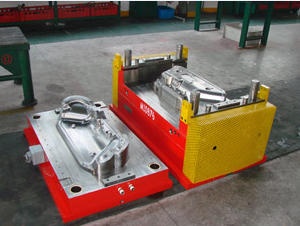
GMT Tool & Compression Moulding for Thermoplastic Composites

Explore GMT tool design and compression tooling technology for Glass Mat Thermoplastic composites. Learn how GMT tools enable lightweight, durable, and recyclable composite components for automotive and industrial applications.

As industries accelerate toward lightweight structures, recyclability, and high-volume production efficiency, the GMT tool has become a critical element in modern thermoplastic composite manufacturing. Glass Mat Thermoplastic (GMT) materials, combined with precision compression tooling, provide an ideal balance between mechanical performance, durability, and sustainable production.

For manufacturers with expertise in compression molding, GMT tooling represents a natural and strategic extension beyond traditional thermoset composite molds.

What Is a GMT Tool?

GMT tool is a compression mold specifically engineered for forming Glass Mat Thermoplastic (GMT) materials under controlled heat and pressure. GMT sheets consist of randomly oriented glass fiber mats impregnated with thermoplastic resins such as polypropylene (PP) or polyamide (PA).

Unlike thermoset-based SMC tooling, GMT compression tooling operates through a heating–forming–cooling cycle rather than a chemical curing reaction. This fundamental difference places higher demands on thermal control, mold rigidity, and dimensional stability.

Key Material Characteristics Driving GMT Tool Design

Thermoplastic Processing Behavior

GMT materials soften when heated and solidify upon cooling. As a result, GMT tooling must provide:

  • Precise and uniform heating for rapid material softening
  • High structural stiffness to withstand forming pressure
  • Efficient cooling channels to minimize cycle time
  • Stable part geometry during demolding and cooling

Repeated thermal cycling makes mold material selection and internal structure essential for long-term tooling durability.

Fiber Distribution and Mechanical Performance

Although GMT uses randomly oriented glass fibers, proper compression mold design ensures controlled material flow, uniform wall thickness, and consistent fiber distribution in load-bearing areas.

A well-designed GMT tool directly influences stiffness, impact resistance, and fatigue performance of the finished composite component.

gmt mold

Advantages of GMT Compression Tooling

High Production Efficiency

One of the most significant advantages of GMT tooling is short cycle time. Since no chemical curing is required, GMT compression molding enables:

  • Fast forming and cooling cycles
  • High repeatability for mass production
  • Lower energy consumption per part

These characteristics make GMT tools ideal for high-volume automotive and commercial vehicle applications.

Lightweight and Durable Structures

GMT components formed with precision compression tooling offer an excellent strength-to-weight ratio combined with high impact resistance and fatigue durability. This makes them suitable for both structural and semi-structural applications.

Recyclability and Sustainability

As thermoplastic composites, GMT materials are inherently recyclable. Scrap and offcuts can be reprocessed, supporting sustainability goals and circular economy requirements.

GMT tooling therefore aligns performance-driven manufacturing with environmental responsibility.

Typical Applications of GMT Tools

GMT tools are widely used to produce durable composite components in:

  • Automotive underbody shields and structural panels
  • Seat frames and interior load-bearing parts
  • Battery protection panels and enclosures
  • Commercial vehicle body components
  • Industrial equipment housings

These applications benefit from GMT’s impact resistance, dimensional stability, and consistent part quality.

GMT mold

Critical Design Considerations for GMT Tools

Mold Structure and Rigidity

GMT compression molding involves high forming pressure. Tool structures must minimize deflection and maintain long-term dimensional accuracy.

High-strength tool steels, optimized rib layouts, and reinforced backing structures are commonly used to ensure durability.

Thermal Management System

Thermal control is the core of GMT tooling performance. Advanced GMT tools integrate:

  • Efficient heating systems for uniform temperature distribution
  • Optimized cooling channels to reduce cycle time
  • Stable thermal gradients to prevent warpage

Surface Quality and Demolding

For visible or functional parts, GMT tools must deliver smooth cavity surfaces, appropriate draft angles, and reliable demolding systems to ensure consistent quality.

GMT Tool vs. SMC Tool: Key Differences

AspectGMT ToolSMC Tool
Resin SystemThermoplasticThermoset
Forming MechanismMelting & CoolingChemical Curing
Cycle TimeShortLonger
RecyclabilityHighLimited

Conclusion

GMT tools are essential for the efficient production of lightweight, durable, and recyclable thermoplastic composite components. Through precise thermal control, robust mold structures, and optimized cavity design, GMT compression tooling supports high-volume manufacturing without compromising performance.

As thermoplastic composites continue to expand across automotiveand industrial sectors, GMT tooling will remain a key technologyfor next-generation composite manufacturing.

GMT Machine Tools: A Ultimate Guide To Learn

Discover GMT machine tools. Learn about their features, applications, and advantages in industries like automotive, aerospace, and construction.

This is your go-to resource for understanding the impact and innovation behind GMT machine tools.

Understanding GMT Machine Tools

GMT machine tools are advanced manufacturing systems used to shape and mold Glass Mat Thermoplastic (GMT) composites.GMT materials are known for their lightweight, durable, and recyclable properties. These materials require specialized tools to meet strict industry standards. These tools are important for high-performance industries such as the automotive, aerospace, construction industries.

Key Features of GMT Machine Tools

  • High Precision: Get consistent results with advanced control systems for pressure, temperature, and cycle times.
  • Durable Design: Built to withstand demanding conditions in high-pressure environments.
  • Automation Ready: Can be integrated with robots for efficient material handling and real-time monitoring.
  • Custom Configurations: Customized solutions for different molding needs, including size and complexity.

These features make GMT machine tools essential for modern composite manufacturing processes.

The GMT Molding Process Explained

  1. Material Preparation: GMT sheets are preheated to make them flexible.
  2. Molding and Compression: The material is placed in precision molds and subjected to high pressure.
  3. Cooling: The molded part is cooled to maintain its shape and size.
  4. Finishing: Edges are trimmed, and surfaces are polished for a flawless finish.

Applications of GMT Machine Tools

GMT machine tools serve a wide range of applications across multiple industries:

1. Automotive Industry

  • These include parts like bumper beams, seat backs, and underbody shields.
  • These parts are designed to absorb energy in a crash and improve safety.

2. Construction Sector

  • These tools can be used to make high-durability roofing panels and wall elements.
  • These include load-bearing components for structural support.

3. Aerospace Industry

  • Lightweight interior components like cabin panels and luggage compartments.
  • Structural parts that can handle extreme conditions.

4. Consumer Goods

  • Durable items such as sports equipment and protective cases.
  • High-performance home appliances.
gmt mold

Benefits of Using GMT Machine Tools

  • Increased Efficiency: High-speed operations reduce production time while maintaining quality.
  • Cost Savings: Durable equipment means less downtime and maintenance costs.
  • Sustainability: They are also eco-friendly because they are made with recyclable and eco-friendly GMT materials.
  • Enhanced Versatility: They are also very versatile and can be used for different designs and materials.

These benefits make GMT machine tools essential for competitive manufacturing.

Future Innovations in GMT Machine Tools

Here are some of the emerging trends in GMT machine tools:

  • Smart Manufacturing: IoT-enabled tools for predictive maintenance and performance analytics.
  • Eco-Friendly Solutions: Support for bio-based GMT materials and efficient recycling systems.
  • Advanced Materials Compatibility: They can also use advanced materials, like tools designed for hybrid GMT composites with carbon fiber reinforcements.
  • Scalable Production: Modular designs for quick adaptation to new product demands.

These advancements are driving the evolution of GMT manufacturing, ensuring adaptability to future market demands.

Conclusion

GMT machine tools are key to advancing composite manufacturing in all kinds of industries. Their ability to deliver precision, efficiency, and sustainability makes them essential for creating lightweight, durable, and cost-effective components.With ongoing innovation and the use of smart technologies, GMT machine tools are set to raise the bar for composite production.

Contact us today to learn how GMT machine tools can elevate your manufacturing capabilities.

What are the advantages of parting surface design?

In order to make the product easy to eject and simplify the ejection system, the position of the parting surface should make the product leave the bottom mold after the mold is opened;

  1. Reduce the damage of flash to the appearance of the product, and at the same time facilitate the removal of flash;
  2. Facilitate mold manufacturing and mold parts processing;
  3. For products with high requirements for radial dimensional accuracy, the effect of flanging thickness on the product accuracy should be considered, and the vertical parting surface should be taken to ensure the radial accuracy of products;
  4. Ensure the strength of the product and avoid sharp angle and weak walls.

It is very important to design the parting surface. The parting design should be carried out at the initial stage of mold design to draw the parting design drawing, so as to ensure the smooth demoulding of the product and facilitate production.

Please keep in touch with us, when any doubts on GMT Mould.

Taizhou Huangyan MDC Mould&Plastic Co.,ltd

Add: No.35-1 Qingfeng Rd, Huangyan North industrial estate, Taizhou City, ZheJiang, China, 318020

E-mail:[email protected]

MDC mould, Compression mould
Tel:+86-576-84616076

MDC in JEC World 2019

2019 JEC world was taken place on 12-14 March as scheduled. As the leading SMC/GMT mould manufacturer in China, MDC Mould always pay close attention to the changed and development of composites Industry.

In regards this composite exhibition, too many experts who have experienced in composite industry focus on the most advanced technology for Aero&Space, Auto&Transport, Construction&Energy, and introduce the discovery for the latest trends per industry. MDC keep to collect the information and growing up year by year

Please keep in touch with us, when any doubts on SMC/GMT Mould.

Taizhou Huangyan MDC Mould&Plastic Co.,ltd

Add: No.35-1 Qingfeng Rd, Huangyan North industrial estate, Taizhou City, ZheJiang, China, 318020

E-mail:[email protected];

Tel:+86-576-84616076

MDC mould, SMC mould, BMC mould, GMT mould, Compression mould

What is GMT MOULD?

MDC specialized in compression mould, GMT mould is one kind of them .

so what is GMT ?

GMT is Glass Mat Reinforced Thermoplasitcs, a kind of sheet molding compound with fiber reinforced thermoplastic. It is produced on huge laminators, using a thermoplastic resin and one or more forms of reinforcement. The process yields a lightweight, partially consolidated, semifinished composite in sheet form. Most forms are produced to 1,300 mm to 1,400 mm widths. However, some newer forms are made to greater but proprietary widths. The sheet stock may be cut to size to suit placement in the tool for a specific application and also can incorporate a decorative or functional surface laminated to one side. GMT mould makes possible the production of large parts with low tooling costs and fast cycle times via compression molding. The potential for parts consolidation presents the opportunity to further reduce weight and cost.

What’s the advantage of GMT mould?

Utilization of regenerated; Low forming pressure; Long storage period; Short shaping cycle; High production efficiency

What’s the mostly application of GMT mold?

GMT mold is mostly used in Automotive and building&construction, chemical industry, packaging, sport equipment, etc.

Please keep in touch with us, when any doubts on GMT Mould.

Taizhou Huangyan MDC Mould&Plastic Co.,ltd

Add: No.35-1 Qingfeng Rd, Huangyan North industrial estate, Taizhou City, ZheJiang, China, 318020

E-mail:[email protected]

Tel:+86-576-84616076

GMT mould, Compression mould

GMT mold

Underbody shield GMT Mold

MDC Mould, as a professional GMT Mold manufacturer, has collaborated with Daimler, Audi, VW, etc, as well as Tier one of car manufacturer.

Underbody shield in passenger car are mostly used GMT process, which is good protective in under-tray when driving. Now we’re honor to introduce GMT material for you as follows:

GMT is Glass Mat Reinforced Thermoplasitcs, a kind of sheet molding compound with fiber reinforced thermoplastic. It is produced on huge laminators, using a thermoplastic resin and one or more forms of reinforcement. The process yields a lightweight, partially consolidated, semifinished composite in sheet form. The sheet stock may be cut to size to suit placement in the tool for a specific application and also can incorporate a decorative or functional surface laminated to one side. GMT mould makes possible the production of large parts with low tooling costs and fast cycle times via compression molding. The potential for parts consolidation presents the opportunity to further reduce weight and cost.

What’s the advantage of GMT mould parts?

Utilization of regenerated; Low forming pressure; Long storage period; Short shaping cycle; High production efficiency

If you have any requirements, please keep in touch with us as below:

Taizhou HuangYan MDC Mould&Plastic Co.,ltd

No.35-1 Qingfeng Rd, Huangyan North industrial estate, Taizhou city, Zhejiang province, China 318020

E-mail:[email protected];

T:+86-576-84616076

MDC mould, GMT mould