Temperature Effects on Fatigue of Thermoset and Thermoplastic Composites

A professional analysis of how temperature influences the static and fatigue performance of thermoset and thermoplastic composites, and what it means for compression mold.

As industries push toward lightweight, high-efficiency, and long-duration structures, the mechanical performance of thermoset composites and thermoplastic composites under extreme environmental conditions has become a critical research topic. Applications in aerospaceautomotivenew energy, and industrial machinery demand composite materials that maintain high stiffness, strength, and fatigue resistance across large temperature variations.

In a recent study, researchers evaluated one commercial thermoset material and two high-performance thermoplastic composites in the temperature range of −30°C to +120°C. These conditions simulate real operating environments such as winter cold starts, under-hood temperatures in vehicles, and heating cycles found in industrial systems. The research provides new insights highly relevant to manufacturers of composite toolingcompression molds, and high-temperature composite components.

1. Static Mechanical Performance: Thermoset vs. Thermoplastic Composites

Tensile tests performed across the full temperature range reveal clear differences in the static behavior between thermoset and thermoplastic materials. The evaluated thermoset composite maintains a relatively stable modulus and tensile strength even as temperature approaches +120°C, confirming its suitability for high-temperature composite mold applications and structural components in automotive environments.

In contrast, the two thermoplastic composites exhibit more significant variations in stiffness and elongation. Their temperature-dependent viscoelastic behavior leads to reduced modulus at high temperatures but improved impact performance at low temperatures. This duality makes them ideal for parts manufactured through compression molding, especially components requiring energy absorption.
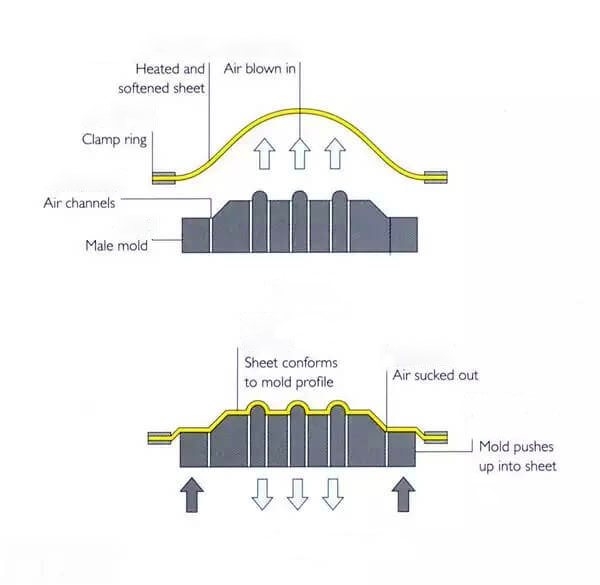
thermoforming

2. Fatigue Behavior Under Extreme Temperatures

The fatigue test results highlight temperature as a dominant factor in long-term structural reliability. At elevated temperatures, polymers undergo chain mobility changes and microstructural relaxation, accelerating fatigue damage. The thermoplastic materials show greater sensitivity to this effect, while the thermoset composite demonstrates superior high-temperature fatigue resistance due to its highly cross-linked network.

This is particularly important for manufacturers of compression-molded composite parts, including:

  • Automotive underbody protection systems
  • EV battery structural housings
  • Engine compartment covers
  • High-load brackets and cross-car beams
  • Industrial pump and motor components

MDC’s expertise in SMC moldBMC moldcarbon fiber mold, and thermoplastic composite mold development ensures reliable processing for these demanding applications.

3. Implications for Composite Mold and Compression Molding Production

Understanding the temperature-dependent fatigue behavior is essential not only for material selection but also for designing advanced composite moulds and compression tooling. Mold temperature control, heating uniformity, and optimized venting must all be aligned with the specific thermal response of the material.

For example:

  • Thermoset composites (e.g., SMC, BMC) require precise temperature control (135–160°C) to ensure full curing.
  • Thermoplastic composites (e.g., LFT, CF-reinforced PP) need rapid heating & cooling cycles to maintain consistency.
  • Carbon-fiber hybrid composites demand stable mold rigidity and low thermal distortion for aerospace-grade accuracy.

These factors directly influence mold lifespan, cycle time, and part repeatability—areas where MDC Mould has extensive industrial experience.

4. Research Funding and Industrial Context

This study is partially funded by the Italian Ministry of Enterprises and Made in Italy (MIMIT) under the project: “New Generation of Modular Intelligent Oleo-dynamic Pumps with Axial Flux Electric Motors.” The research aligns strongly with global industry trends in improving thermal stability and mechanical reliability of composite components used in motors, pumps, automotive assemblies, and energy systems.

Conclusion

The investigation into the temperature-dependent fatigue performance of thermoset and thermoplastic composites provides critical insights for high-precision composite manufacturing. As the automotive and energy industries transition toward lightweight structures, the demand for temperature-resistant, high-fatigue-strength materials will continue to rise.

With advanced technical capability in SMC moldsBMC moldscarbon fiber moldsthermoplastic composite molds, and large-format composite toolingMDC Mould is positioned to support global customers developing next-generation high-performance composite parts.
Curing Cycle Optimization in Compression Molding

Discover how Zhejiang MDC Mould optimizes the curing cycle in compression molding to enhance the strength, precision, and efficiency of composite components for automotive and industrial applications.

In the field of compression molding for composite materials, the curing cycle is one of the most decisive factors determining product performance, dimensional accuracy, and production efficiency. At Zhejiang MDC Mould Co., Ltd., mastering the curing cycle is not just process control—it is the essence of MDC’s precision engineering and its leadership in advanced composite mold manufacturing.

What Is the Curing Cycle in Compression Molding?

The curing cycle refers to the specific combination of time, temperature, and pressure applied to thermosetting composite materials within a compression mold. During this stage, materials such as SMC (Sheet Molding Compound) or BMC (Bulk Molding Compound) undergo crosslinking reactions that transform them from a semi-solid state into a rigid, durable component with stable mechanical properties.

A typical curing cycle involves three stages:

  • Heating phase: The mold is heated (130°C–170°C) to initiate resin polymerization.
  • Holding phase: The material remains under constant heat and pressure for full crosslinking.
  • Cooling phase: Controlled cooling solidifies the material and reduces internal stress before demolding.
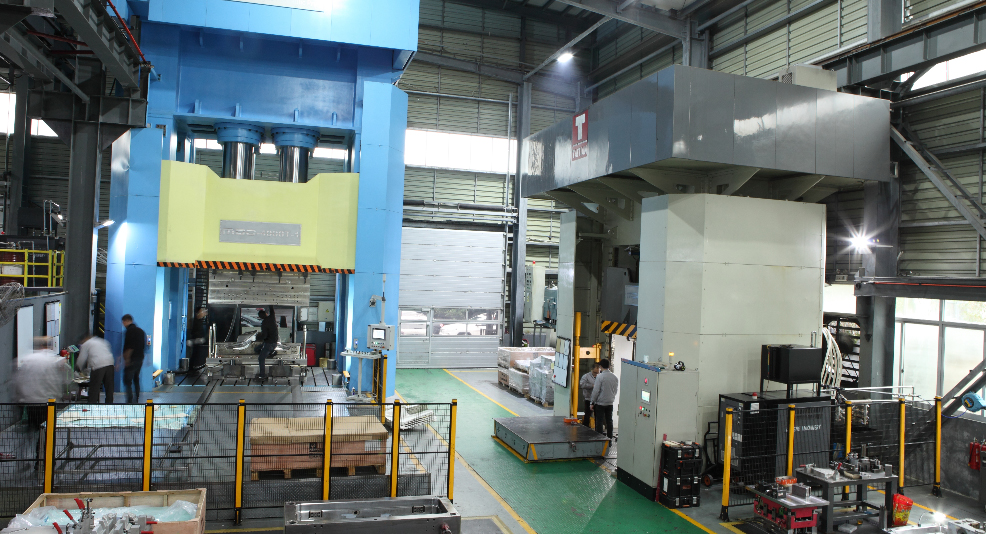
compression-mould-machine

Why Curing Cycle Optimization Matters

For high-precision SMC and BMC molds designed by MDC, controlling the curing cycle is essential for ensuring consistent quality. If the curing cycle is too short, the resin may not fully crosslink, leading to surface or strength defects. If too long, unnecessary energy consumption and lower production efficiency result.

An optimized curing cycle ensures:

  • Stable mechanical performance — full crosslinking enhances strength and durability.
  • Dimensional precision — balanced curing prevents deformation and shrinkage.
  • Superior surface finish — precise curing leads to smooth, paint-ready surfaces.
  • Higher production efficiency — shorter cycles increase output and reduce costs.

Factors Influencing the Curing Cycle

The curing behavior within a compression mold depends on multiple factors:

  • Resin system: Polyester, epoxy, and phenolic resins each have distinct curing characteristics.
  • Reinforcement type: Fiber orientation, filler type, and content affect heat transfer.
  • Part geometry: Thicker sections require longer curing times to achieve uniformity.
  • Mold temperature control: Even heating ensures consistent curing throughout the cavity.
  • Venting and pressure: Proper venting avoids trapped air and ensures smooth resin flow.

MDC’s Engineering Approach to Curing Cycle Management

At MDC Mould, every compression mold is engineered with precise thermal management in mind. The company integrates finite element simulation and thermal flow analysis to predict temperature uniformity and curing behavior across complex cavities. This allows engineers to optimize the mold’s heating system and define ideal processing parameters before production begins.

MDC also utilizes:

  • Embedded thermal sensors for real-time temperature monitoring.
  • High-efficiency heating channels for rapid, uniform heat distribution.
  • Digital data systems linking process control with resin curing kinetics.

This approach ensures that each mold achieves an optimal balance between curing time, temperature, and pressure—guaranteeing reliable and repeatable composite part quality.

Case Study: SMC Roof Panel Mold for Electric Vehicle

In a recent project, MDC developed an SMC roof panel compression mold for a leading new energy vehicle manufacturer. By applying advanced thermal simulations and refining the curing schedule, MDC reduced the total cycle time by 20% while maintaining full crosslinking and high-gloss surface quality. The optimized curing cycle also minimized energy consumption and extended mold lifespan.

This success demonstrates MDC’s unique capability to merge curing cycle control with compression mold design excellence.

The Future of Curing Technology in Compression Molding

The next stage of curing optimization lies in smart manufacturing. MDC is developing intelligent compression molding systems that integrate AI-based thermal management, real-time curing monitoring, and predictive control algorithms. These innovations enable adaptive process adjustments—ensuring consistent curing performance, reduced energy use, and faster production cycles.

Conclusion

The curing cycle represents the heart of the compression molding process. Its precision defines not only the mechanical strength and dimensional accuracy of composite products but also overall manufacturing efficiency and sustainability. Through decades of experience and technological innovation, Zhejiang MDC Mould Co., Ltd. continues to advance the science of curing cycle optimization, delivering superior compression molds that empower global composite production with quality, consistency, and intelligence.