In modern industrial manufacturing, thermoforming tools play a crucial role in shaping thermoplastic sheets and composite materials into lightweight, high-precision components. As industries continue to pursue lightweight engineering, efficient production, and advanced material performance, thermoforming technology has become one of the most widely adopted forming processes worldwide.
A thermoforming tool is a precision mold used to form heated thermoplastic sheets or composite laminates into specific geometries through vacuum, pressure, or mechanical force. The quality of the thermoforming tool directly determines the dimensional accuracy, surface quality, structural integrity, and production efficiency of the final molded parts.
Industries such as automotive manufacturing, aerospace engineering, industrial equipment production, and packaging technology increasingly rely on advanced thermoforming molds to manufacture complex plastic and composite components with consistent performance and high production efficiency.
What Is a Thermoforming Tool?
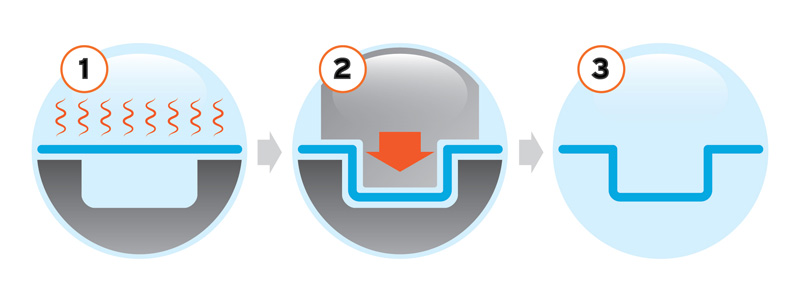
A thermoforming tool is a specialized mold used in the thermoforming process, where thermoplastic sheets are heated until they reach a soft, formable state and are then shaped over a mold surface. Once the material conforms to the mold geometry, it is cooled to retain the final component structure.
Thermoforming tooling is widely used because it enables manufacturers to produce large, lightweight parts with relatively low tooling costs compared with injection molding. The technology is particularly suitable for medium-to-large components that require precise geometry and smooth surface finishes.
Typical Thermoforming Process
- Heating thermoplastic sheets to forming temperature
- Positioning the heated material over the thermoforming mold
- Applying vacuum or pressure to shape the material
- Cooling the formed component while maintaining mold geometry
- Trimming and finishing the final product
Because thermoforming relies heavily on mold accuracy and temperature control, high-precision thermoforming tooling is essential for stable and repeatable production.
Main Types of Thermoforming Tools
Vacuum Thermoforming Tool
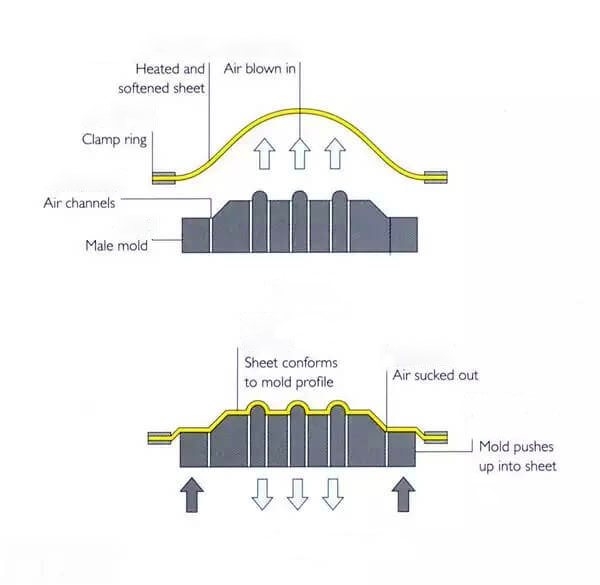
Vacuum thermoforming tools use negative air pressure to draw heated plastic sheets onto the mold surface. Small vent holes within the mold allow air to escape, ensuring that the plastic material conforms precisely to the mold cavity.
Vacuum forming tools are commonly used for manufacturing:
- automotive interior panels
- plastic packaging trays
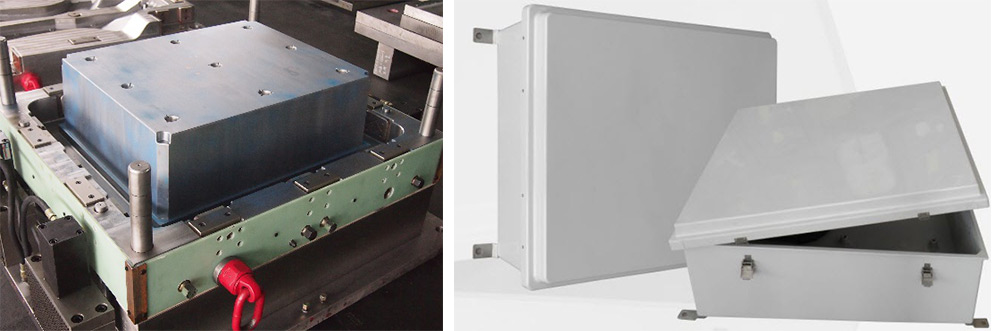
- equipment housings
- protective covers and enclosures
Pressure Thermoforming Tool
Pressure thermoforming combines vacuum with positive air pressure to force the heated plastic sheet against the mold surface. This method allows for greater detail reproduction and sharper features.
Pressure forming molds are widely used for:
- automotive exterior panels
- consumer appliance housings
- electronic equipment panels
- industrial machine covers
Twin Sheet Thermoforming Tool
Twin sheet thermoforming tools form two heated plastic sheets simultaneously and bond them together inside the mold. This process allows the creation of hollow structural components with improved rigidity.
Typical applications include:
- automotive air ducts
- industrial equipment structures
- large structural plastic panels
Materials Used in Thermoforming Mold Manufacturing
Aluminum Thermoforming Tools
Aluminum is one of the most commonly used materials for thermoforming molds because it provides excellent thermal conductivity, lightweight structure, and efficient machinability. Aluminum tooling is ideal for prototype production and medium-volume manufacturing.
Steel Thermoforming Tools
Steel molds are typically used for high-volume production environments where durability and wear resistance are essential. Steel thermoforming tools provide long service life and excellent dimensional stability during repeated heating cycles.
Composite Thermoforming Tools
Composite tooling materials such as fiberglass or carbon fiber structures may be used in specialized thermoforming applications. These materials are particularly suitable for lightweight prototype tooling and aerospace component manufacturing.
Key Design Factors for Thermoforming Tooling
Mold Surface Engineering
The mold surface must ensure smooth material flow to prevent defects such as thinning, wrinkles, or uneven wall thickness. Precision polishing and surface treatment improve the final appearance of thermoformed components.
Temperature Management
Uniform temperature distribution across the thermoforming mold ensures consistent forming conditions. Advanced tooling designs often incorporate cooling channels or thermal management systems to stabilize the molding process.
Venting System
Small vent holes within vacuum thermoforming molds allow trapped air to escape, enabling the heated sheet to conform completely to the mold surface.
Structural Strength
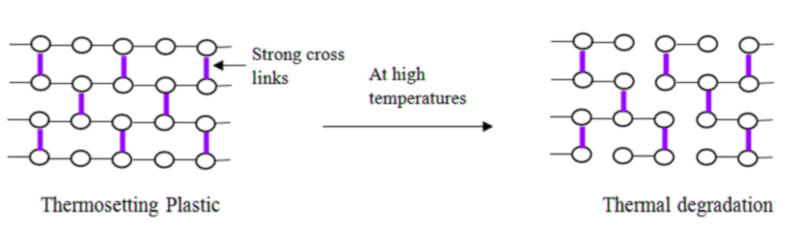
Thermoforming tools must withstand repeated heating cycles and forming pressure without deformation. High-strength mold materials ensure long-term production reliability.
Industrial Applications of Thermoforming Tools
Automotive Manufacturing
Thermoforming tools are widely used to produce lightweight automotive components, including interior panels, trunk liners, battery covers, and protective underbody panels.
Aerospace Components
In aerospace manufacturing, thermoforming tooling is used for aircraft interior panels, cabin structures, and lightweight composite components where weight reduction is critical.
Industrial Equipment
Industrial thermoforming molds produce durable equipment housings, machine covers, and protective enclosures used in manufacturing facilities and industrial environments.
Packaging Industry
Thermoforming tooling is extensively used in packaging production, enabling high-volume manufacturing of food packaging trays, medical packaging, and protective product packaging.
Advantages of Thermoforming Tooling
- High production efficiency
- Lower tooling cost compared with injection molding
- Ability to produce large components
- Excellent design flexibility
- Consistent product quality
These advantages make thermoforming an important technology for producing thermoplastic and composite components across multiple industries.
Frequently Asked Questions About Thermoforming Tools
What is a thermoforming tool?
A thermoforming tool is a mold used to shape heated thermoplastic sheets into specific geometries using vacuum or pressure forming technology.
What materials are used to manufacture thermoforming molds?
Thermoforming molds are commonly manufactured from aluminum, steel, or composite materials depending on production volume and application requirements.
What industries use thermoforming tooling?
Thermoforming tooling is widely used in automotive manufacturing, aerospace production, industrial equipment manufacturing, and packaging industries.
Conclusion
A thermoforming tool is a critical component in thermoplastic and composite manufacturing processes. High-precision thermoforming molds enable manufacturers to produce lightweight components with excellent surface quality and consistent dimensional accuracy.
As global industries continue to focus on lightweight materials, sustainable production, and efficient manufacturing technologies, advanced thermoforming tooling will remain an essential solution for producing high-performance plastic and composite components.