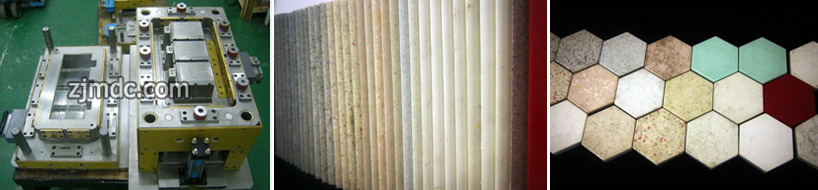
Why Carbon Fiber Mould Accuracy Determines Composite Part Quality ?

Discover how MDC precision carbon fiber moulds eliminate thermal warpage. Engineered with CTE matching, 5-axis CNC tolerances, and Class-A surface finishing for autoclave & compression molding.

Carbon fiber composites are widely used in aerospace, automotive, energy, sports equipment, and industrial applications because of their exceptional strength-to-weight ratio, corrosion resistance, and design flexibility. However, producing high-quality carbon fiber components requires far more than selecting premium materials. The accuracy of the carbon fiber mould plays a decisive role in determining dimensional precision, surface finish, structural integrity, and production consistency.

Modern composite manufacturing demands increasingly tighter tolerances and higher cosmetic standards. Whether components are produced through compression molding, resin transfer molding (RTM), vacuum infusion, or prepreg processing, the mould serves as the foundation of the entire manufacturing process. Even minor tooling deviations can affect laminate quality, curing consistency, and final assembly performance.

At MDC, we specialize in designing and manufacturing precision carbon fiber moulds for demanding composite applications. By combining advanced CNC machining, precision polishing, optimized venting, and robust mould structures, we help manufacturers achieve stable production, excellent repeatability, and long service life.

Why Precision Is Critical in Carbon Fiber Composite Manufacturing

Unlike conventional plastic components, carbon fiber composite parts often function as structural elements that must withstand high mechanical loads while maintaining strict dimensional accuracy. Small variations in mould geometry can directly influence fiber orientation, resin distribution, laminate thickness, and bonding quality.

For industries such as aerospace and automotive manufacturing, dimensional deviations of only a fraction of a millimeter may lead to assembly difficulties, increased finishing work, or even product rejection. Therefore, mould precision is not simply a quality requirement—it is a key factor affecting production efficiency and component reliability.

  • Improves dimensional accuracy and assembly consistency
  • Enhances laminate thickness control
  • Supports uniform fiber consolidation
  • Reduces post-processing requirements
  • Improves repeatability in mass production
  • Minimizes manufacturing defects and material waste
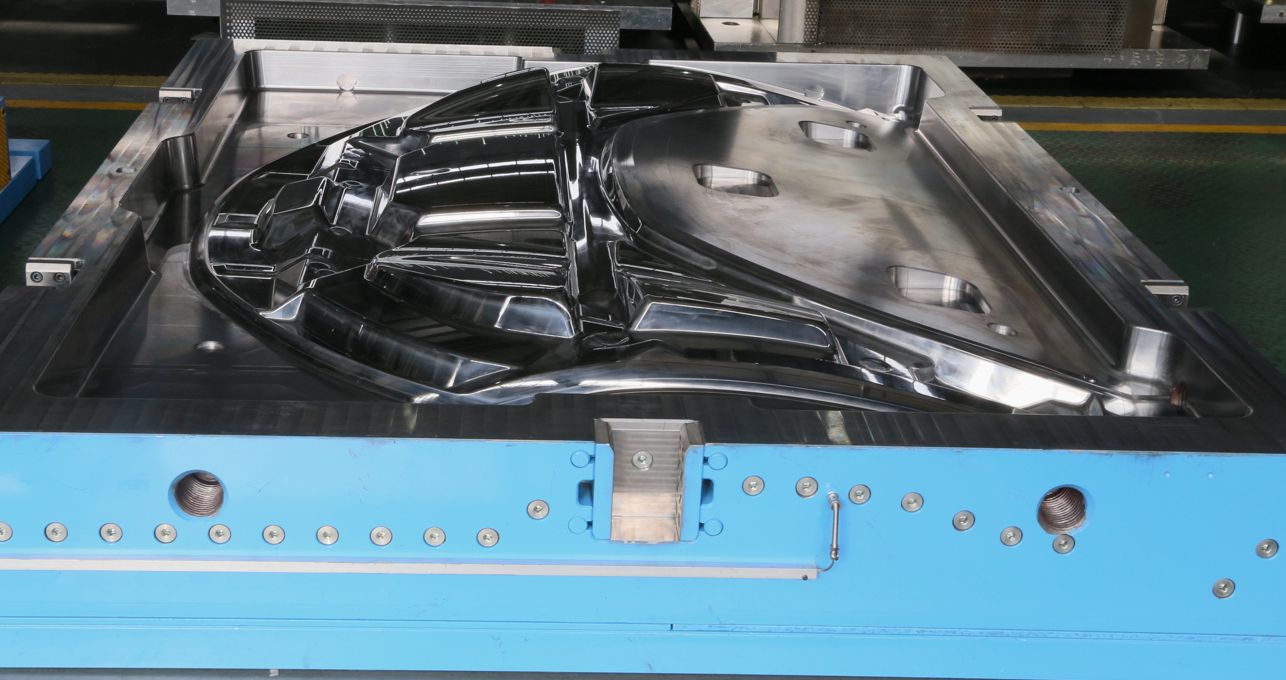
carbon fiber mould

How Carbon Fiber Mould Design Influences Composite Part Quality

A high-performance carbon fiber mould is much more than a cavity that defines part geometry. Every design feature—including cavity accuracy, structural rigidity, draft angles, heating channels, and venting systems—affects how composite materials behave during the molding cycle.

Dimensional Accuracy

Precision machining ensures that every contour, radius, and mating surface conforms to engineering drawings. Accurate mould geometry reduces assembly variation and supports the production of complex composite structures with consistent dimensions.

Structural Rigidity

During compression molding or autoclave curing, moulds experience significant thermal and mechanical loads. A rigid mould structure minimizes deformation, maintains cavity accuracy, and preserves long-term production stability.

Draft Angle Optimization

Proper draft angles facilitate smooth demoulding while protecting delicate composite surfaces from scratches, cracks, or edge damage. Optimized draft design also reduces production downtime and extends mould service life.

Surface Finish Directly Affects Composite Appearance

The surface quality of the mould is directly transferred to the finished carbon fiber component. Even microscopic imperfections on the mould surface may appear on high-gloss composite parts, increasing finishing work and reducing product quality.

Depending on application requirements, mould cavities may undergo precision polishing to achieve mirror-quality surfaces or engineered textures. A properly finished mould offers several manufacturing advantages:

  • Improved cosmetic appearance
  • Lower demoulding resistance
  • Reduced resin adhesion
  • Better release consistency
  • Lower maintenance frequency
  • Longer mould service life

CNC Machining Accuracy: The Foundation of a Precision Carbon Fiber Mould

The manufacturing quality of a carbon fiber mould begins with precision machining. High-performance composite parts often require tight dimensional tolerances and complex geometries that can only be achieved through advanced CNC machining technology. Every contour, cavity, and mating surface must be manufactured with exceptional accuracy to ensure that the finished composite component matches its design specifications.

Modern multi-axis CNC machining centers allow engineers to produce complex mould surfaces with excellent repeatability while minimizing machining errors. Combined with precision EDM, grinding, and manual fitting, these processes ensure that each mould component fits together accurately throughout the production cycle.

High machining accuracy delivers several important benefits:

  • Consistent dimensional accuracy across production batches
  • Improved assembly compatibility for structural components
  • Reduced manual trimming and secondary machining
  • Lower rejection rates during quality inspection
  • Higher production efficiency and repeatability
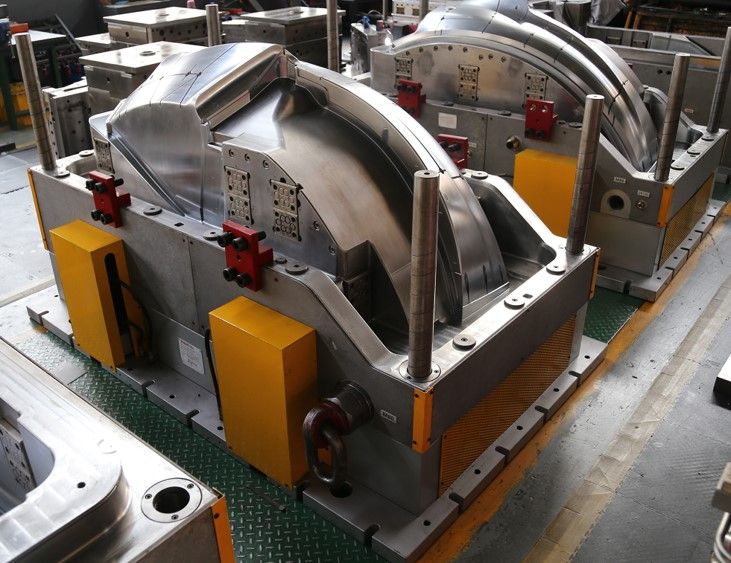
carbon fiber mould manufacture

Thermal Stability Ensures Consistent Composite Curing

Carbon fiber composites are highly sensitive to curing temperature. Whether using prepreg materials, compression molding compounds, or resin infusion systems, the mould must provide stable and uniform thermal conditions throughout the curing cycle. Uneven temperatures can lead to inconsistent resin flow, incomplete curing, residual stress, and dimensional distortion.

A properly engineered mould incorporates balanced heating channels and optimized thermal distribution to minimize temperature variations across the cavity surface. Maintaining thermal stability improves curing consistency while reducing the risk of warpage and internal defects.

  • Uniform resin curing
  • Reduced residual stress
  • Improved laminate consolidation
  • Better dimensional stability
  • Consistent mechanical properties
  • Shorter and more predictable production cycles

Venting Design Prevents Composite Defects

During carbon fiber molding, trapped air and volatile gases must be removed from the mould cavity before the resin fully cures. Without an effective venting system, air pockets may remain inside the laminate, creating voids that reduce structural strength and negatively affect surface quality.

Engineers carefully position venting features to allow gases to escape while preventing excessive resin loss. Proper venting is particularly important for complex geometries and thick composite laminates where airflow paths are more restricted.

An optimized venting system helps manufacturers reduce:

  • Air entrapment
  • Internal voids
  • Surface pinholes
  • Dry fiber areas
  • Incomplete cavity filling
  • Laminate delamination

Vacuum Sealing Improves Laminate Quality

For many advanced composite manufacturing processes, vacuum assistance is used to remove air from the laminate before curing. The mould must provide excellent sealing performance to maintain stable vacuum pressure throughout the process.

Leakage around mould parting surfaces or sealing grooves can reduce vacuum efficiency, allowing air to remain inside the laminate. This may result in porosity, inconsistent fiber consolidation, and reduced mechanical performance.

Precision-machined sealing surfaces and properly designed gasket systems help ensure stable vacuum conditions, producing composite parts with improved density, strength, and cosmetic appearance.

Selecting the Right Tool Material for Carbon Fiber Moulds

Tool material selection influences machining performance, thermal conductivity, durability, and overall production cost. The most suitable material depends on production volume, mould size, processing temperature, and surface quality requirements.

Tool MaterialAdvantagesTypical Applications
P20 Tool SteelCost-effective with good machinabilityPrototype and medium-volume production
H13 Tool SteelExcellent thermal fatigue resistanceHigh-volume compression molding
Aluminum AlloyHigh thermal conductivity and lightweightPrototype tools and low-volume composite production
InvarExtremely low thermal expansionAerospace composite tooling requiring exceptional dimensional stability

Material selection should always balance production requirements, expected tool life, manufacturing efficiency, and total lifecycle cost rather than focusing solely on initial tooling investment.

Common Carbon Fiber Mould Challenges and Engineering Solutions

Even with advanced composite materials and automated production equipment, tooling quality remains one of the primary factors influencing manufacturing success. Identifying potential mould-related issues early allows manufacturers to reduce production risks and improve long-term process stability.

Manufacturing ChallengePossible CauseRecommended Solution
Dimensional DeviationInsufficient machining accuracy or mould deformationImprove CNC precision and increase mould rigidity
Surface ImperfectionsPoor polishing or cavity contaminationOptimize polishing processes and regular mould cleaning
Voids and PorosityInadequate venting or vacuum leakageImprove vent design and sealing performance
Resin AccumulationImproper cavity geometry or uneven pressureOptimize mould design and molding parameters
Difficult DemouldingInsufficient draft angle or worn mould surfacesRefine draft design and maintain cavity finish
Warping After CuringUneven temperature distribution or residual stressImprove thermal balance and controlled cooling

Addressing these issues through engineering-focused mould design helps manufacturers improve product consistency, reduce material waste, and achieve reliable long-term composite production.

Applications of Precision Carbon Fiber Moulds

As composite materials continue to replace traditional metals in high-performance engineering, precision carbon fiber moulds are becoming essential across a wide range of industries. Lightweight design, excellent mechanical properties, and design flexibility have accelerated the adoption of carbon fiber composites in applications where dimensional accuracy and structural integrity are critical.

High-quality tooling ensures that complex composite components can be manufactured with consistent dimensions, reliable mechanical performance, and excellent surface finish, even during high-volume production.

Aerospace Components

The aerospace industry demands exceptional dimensional precision and repeatability. Carbon fiber moulds are widely used to manufacture aircraft interior panels, structural reinforcements, fairings, radomes, and other lightweight composite components where weight reduction contributes directly to fuel efficiency and payload capacity.

  • Aircraft interior structures
  • Wing and fuselage components
  • Radomes and fairings
  • Satellite composite structures

Automotive Lightweight Components

Automotive manufacturers increasingly rely on carbon fiber composites to reduce vehicle weight while maintaining strength and safety. Precision moulds support the production of body panels, battery enclosures, aerodynamic parts, and structural reinforcements with consistent quality.

  • Body panels
  • Roof systems
  • Battery covers
  • Underbody protection panels
  • Structural reinforcements

Hydrogen Energy and New Energy Applications

Carbon fiber composites are widely used in hydrogen storage systems and new energy equipment because of their excellent strength-to-weight ratio and corrosion resistance. Precision tooling supports the production of composite structures that require strict dimensional control and long-term reliability.

Sports and Recreation Equipment

Manufacturers of bicycles, racing equipment, marine products, and sporting goods rely on precision moulds to produce lightweight carbon fiber components with attractive cosmetic finishes and excellent mechanical performance.
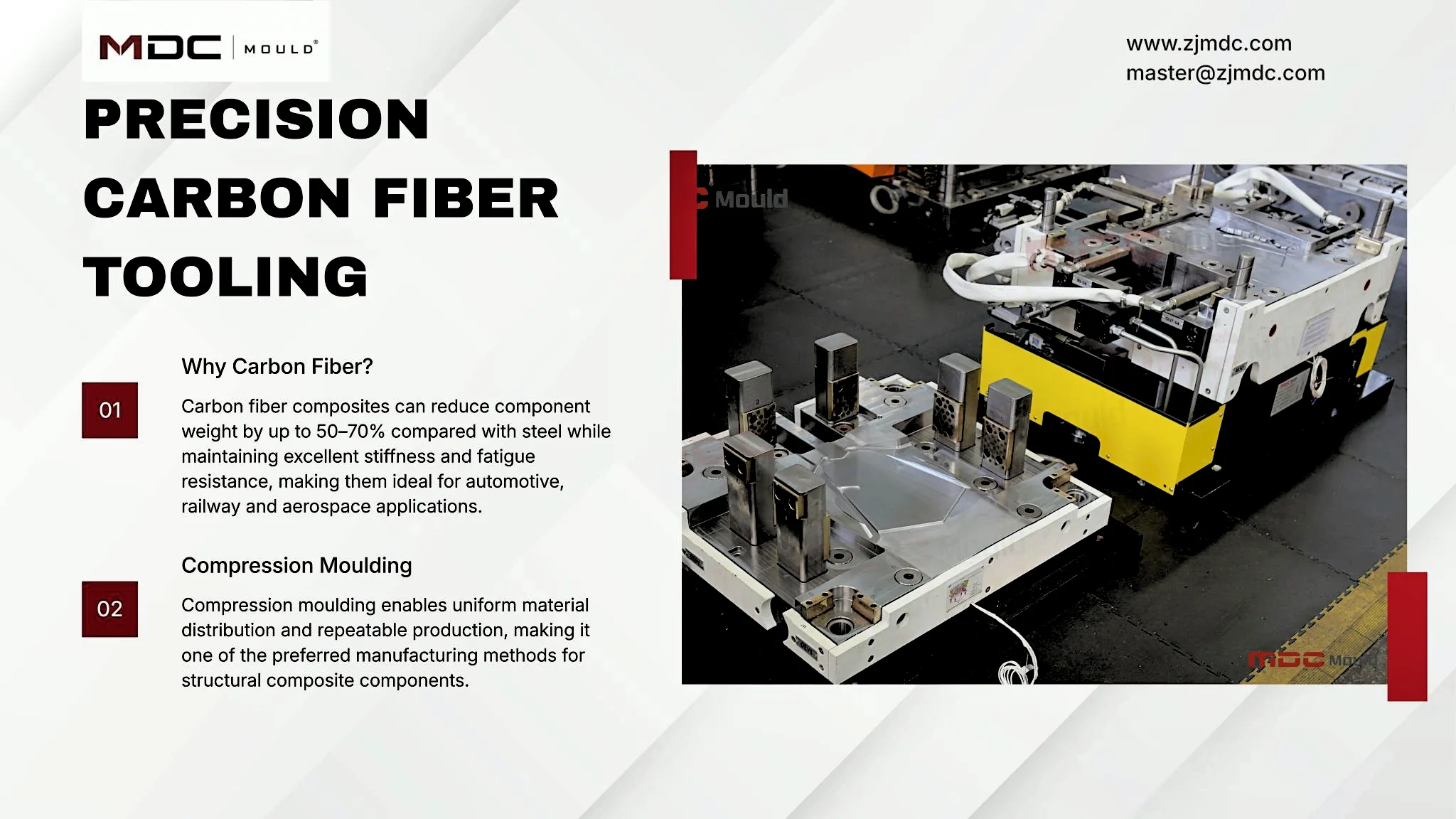
carbon fiber tooling

How MDC Manufactures Precision Carbon Fiber Moulds

At MDC, every carbon fiber mould is developed through a structured engineering process that combines advanced design software, precision machining technology, and comprehensive quality control. Our objective is to deliver tooling that performs reliably throughout its entire production lifecycle while supporting consistent composite part quality.

Engineering and DFM Review

Each project begins with an engineering evaluation of the customer’s product drawings, composite material system, molding process, and production targets. Design for Manufacturability (DFM) analysis helps optimize cavity design, mould structure, and production efficiency before manufacturing begins.

Precision CNC Machining

High-speed CNC machining centers are used to manufacture complex mould cavities with exceptional dimensional accuracy. Precision milling is combined with EDM, grinding, and manual fitting to ensure accurate assembly and smooth cavity transitions.

Surface Finishing and Polishing

The mould surface is polished according to customer requirements, ranging from engineering-grade finishes to mirror-quality surfaces for visible composite components. High-quality polishing improves demoulding performance while enhancing the appearance of finished parts.

Assembly and Functional Verification

After machining, every mould is assembled, inspected, and tested to verify cavity alignment, sealing performance, and functional accuracy. Trial production helps confirm that the mould performs as expected before delivery.

Quality Control for Carbon Fiber Tooling

Maintaining consistent mould quality requires systematic inspection throughout every manufacturing stage. Rather than relying solely on final inspection, MDC integrates quality verification into the complete production workflow.

Manufacturing StageInspection Focus
Raw Material InspectionSteel certification, hardness, and material verification
CNC MachiningCritical dimensions, cavity geometry, and machining tolerances
Component FittingAssembly accuracy and alignment verification
Surface FinishingPolishing quality and cavity surface condition
Functional TestingTrial molding, dimensional verification, and production evaluation
Final InspectionCompliance with customer drawings and technical specifications

This structured quality management approach minimizes production risks and helps ensure that every mould delivers reliable performance throughout long-term manufacturing.

Why Choose MDC for Carbon Fiber Mould Manufacturing?

Choosing a reliable tooling partner is just as important as selecting advanced composite materials. Precision mould manufacturing requires engineering expertise, machining capability, and a deep understanding of composite production processes.

MDC provides customized carbon fiber tooling solutions for customers worldwide, supporting applications from prototype development to high-volume manufacturing. Every project is engineered to improve production efficiency, reduce manufacturing variation, and maximize long-term tooling performance.

  • Customized mould design based on product requirements
  • Extensive experience in composite and compression mould manufacturing
  • Advanced CNC machining and precision EDM capabilities
  • Optimized venting and thermal management design
  • Comprehensive quality inspection throughout production
  • Prototype, pilot, and mass-production tooling solutions
  • Professional engineering communication and technical support
  • Reliable global project delivery

Whether your project involves aerospace structures, lightweight automotive components, hydrogen energy systems, or industrial composite products, MDC is committed to delivering precision carbon fiber moulds engineered for accuracy, durability, and long-term production reliability.

Frequently Asked Questions About Carbon Fiber Moulds

What is a carbon fiber mould?

A carbon fiber mould is a precision tool used to manufacture carbon fiber composite components through processes such as compression molding, prepreg lay-up, resin transfer molding (RTM), vacuum infusion, and autoclave curing. The mould determines the final shape, dimensional accuracy, surface finish, and production consistency of every composite part.

Why is mould accuracy important for carbon fiber composites?

Carbon fiber components are often used in structural applications where tight tolerances are essential. High mould accuracy helps maintain laminate thickness, improve assembly precision, reduce secondary machining, and ensure consistent mechanical performance throughout production.

Which materials are commonly used for carbon fiber moulds?

The most common mould materials include P20 tool steel, H13 tool steel, aluminum alloys, and Invar. The selection depends on production volume, curing temperature, required dimensional stability, and expected mould life. Aerospace applications often use Invar because of its extremely low coefficient of thermal expansion.

How does surface finish affect carbon fiber parts?

The cavity surface of the mould is directly replicated on the finished composite part. A high-quality polished surface improves cosmetic appearance, reduces release resistance, minimizes finishing work, and supports stable production quality.

Why is venting important in composite moulds?

Effective venting removes trapped air and gases during the molding process. Proper vent design reduces voids, pinholes, dry fiber areas, and other internal defects while improving laminate consolidation and overall structural integrity.

Can carbon fiber moulds be customized?

Yes. Carbon fiber moulds are typically custom-designed according to part geometry, manufacturing process, composite material system, production volume, and customer quality requirements. Each project requires a tailored engineering solution to achieve the desired performance.

How long does a carbon fiber mould last?

Tool life depends on mould material, production conditions, maintenance practices, and manufacturing quality. With appropriate tool steel selection, precision machining, and preventive maintenance, a carbon fiber mould can support long-term, high-volume production while maintaining dimensional accuracy.

How does MDC ensure mould quality?

MDC follows a complete manufacturing workflow that includes DFM analysis, precision CNC machining, EDM processing, assembly inspection, cavity polishing, dimensional verification, and trial molding. Quality control is performed throughout the manufacturing process to ensure stable tooling performance.

Which industries benefit most from precision carbon fiber moulds?

Precision carbon fiber moulds are widely used in aerospace, automotive, electric vehicles, hydrogen energy systems, rail transportation, marine engineering, sports equipment, medical devices, and industrial composite manufacturing.

Why choose MDC for carbon fiber mould manufacturing?

MDC combines extensive experience in composite tooling, precision machining, thermal control design, and quality management to manufacture customized carbon fiber moulds that deliver excellent dimensional accuracy, long service life, and stable production performance.

Conclusion

As carbon fiber composites continue to replace traditional materials in lightweight engineering, the demand for precision tooling has never been greater. While advanced fibers and resin systems provide outstanding mechanical performance, the quality of the final component ultimately depends on the engineering accuracy of the mould.

A well-designed carbon fiber mould does more than define part geometry. It controls dimensional accuracy, fiber consolidation, thermal stability, surface quality, resin flow, and production repeatability. These factors work together to reduce manufacturing defects, improve process efficiency, and ensure reliable long-term product performance.

At MDC, we combine engineering expertise, advanced CNC machining, precision surface finishing, optimized thermal management, and comprehensive quality control to manufacture high-performance carbon fiber moulds for customers worldwide. Every tooling project is developed with a focus on precision, durability, and manufacturing efficiency.

Whether you are developing lightweight automotive components, aerospace structures, hydrogen energy systems, or other advanced composite products, MDC is committed to providing customized carbon fiber mould solutions that support reliable production and long-term manufacturing success.

BMC Mold: Complete Guide to BMC Tooling Design, Manufacturing and Compression Molding Solutions

Bulk Molding Compound (BMC) has become an important engineering material for producing high-performance composite components that require excellent strength, dimensional stability, electrical insulation, and heat resistance. From automotive parts and electrical housings to industrial equipment components, BMC molding provides manufacturers with an efficient solution for producing complex-shaped products with consistent quality.

However, achieving reliable BMC molding performance depends heavily on the quality of the tooling. A precision-engineered BMC mold ensures accurate cavity dimensions, stable material flow, uniform curing, excellent surface finish, and long-term production reliability.

At MDC, we specialize in manufacturing customized BMC mould and BMC tooling solutions for global customers. Our engineering team combines advanced mold design, precision machining, surface finishing, and compression molding experience to deliver reliable tools for automotive, electrical, industrial, and composite applications.

Whether you need a prototype BMC tool or high-volume production tooling, MDC provides complete solutions from initial design analysis and mold development to trial molding and final production support.

What Is a BMC Mold?

A BMC mold is a precision compression molding tool specifically designed for processing Bulk Molding Compound materials. The mold consists of accurately machined cavities, heating systems, guiding components, ejector mechanisms, and other functional structures required to form composite parts under controlled pressure and temperature.

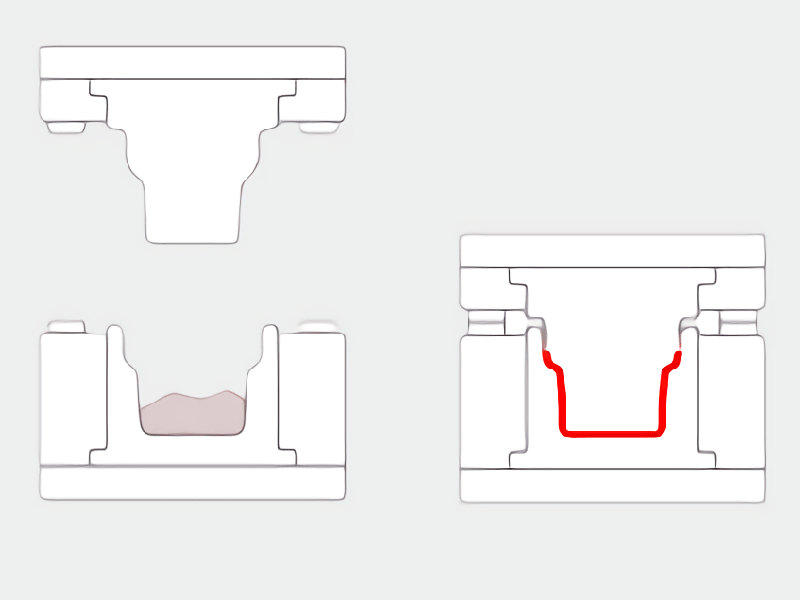
Unlike traditional plastic injection molds, BMC molds operate under compression molding conditions. The material is placed into the heated cavity, compressed under controlled pressure, and cured to form a finished component with excellent mechanical and thermal properties.

Because BMC materials contain chopped glass fibers, resin systems, fillers, and additives, the mold design must carefully consider material flow behavior, fiber distribution, curing characteristics, and demolding requirements.

BMC

Understanding BMC Molding Process

BMC molding is a thermoset composite manufacturing process that uses heat and pressure to transform Bulk Molding Compound into finished components. The process is widely used because it provides excellent dimensional accuracy, high production efficiency, and repeatable part quality.

  1. BMC material preparation
  2. Material weighing and loading
  3. Mold cavity preparation
  4. Material placement into cavity
  5. Compression molding under controlled pressure
  6. Heating and curing process
  7. Mold opening and part removal
  8. Flash trimming and finishing
  9. Dimensional inspection

During the molding cycle, the BMC material flows inside the cavity while heat activates the resin curing reaction. The mold must maintain accurate temperature distribution and pressure control to achieve consistent product performance.

Why BMC Mold Quality Matters

The performance of BMC molded parts depends directly on the precision and engineering quality of the mold. Even small tooling problems can result in dimensional variation, surface defects, incomplete filling, excessive flash, or reduced mechanical performance.

A high-quality BMC tooling system provides:

  • Stable cavity dimensions
  • Uniform material flow
  • Consistent curing performance
  • Excellent surface finish
  • Reduced production defects
  • Longer tooling service life
  • Lower maintenance requirements

For high-volume BMC production, the mold is not simply a forming tool. It is a critical production asset that directly affects manufacturing efficiency, product reliability, and overall production cost.

Applications of BMC Mold

Due to its excellent electrical insulation, heat resistance, corrosion resistance, and dimensional stability, BMC is widely used in industries requiring reliable composite components. Precision BMC molds enable manufacturers to produce complex parts with consistent quality.

Electrical Components

BMC has been widely adopted in electrical applications because of its excellent insulation properties and flame resistance. BMC tooling is commonly used to manufacture:

  • Electrical enclosures
  • Switchgear components
  • Circuit breaker housings
  • Insulator parts
  • Meter boxes

Automotive Components

Automotive manufacturers use BMC molding for lightweight, heat-resistant, and dimensionally stable components, including:

  • Engine components
  • Lighting reflectors
  • Electrical housings
  • Structural composite parts
  • Under-hood components

Industrial Applications

BMC tools are also widely applied in industrial equipment, machinery components, household appliances, and other products requiring durable composite materials.

BMC Mold Design Principles

The design quality of a BMC mold directly determines molding stability, production efficiency, and final component performance. Unlike conventional plastic molds, BMC tooling must consider the unique characteristics of thermoset composite materials, including fiber reinforcement, resin curing behavior, shrinkage, heat transfer, and material flow.

A well-designed BMC tool should achieve a balance between dimensional accuracy, durability, production speed, and maintenance efficiency. Every design element, from cavity structure to heating layout, contributes to the overall success of the molding process.

Cavity Design and Dimensional Accuracy

The mold cavity defines the final geometry of the BMC component. High-precision cavity machining is essential because even minor dimensional errors can affect product assembly, sealing performance, and functional reliability.

During BMC molding, engineers must consider material shrinkage after curing. Proper shrinkage compensation is incorporated into the mold design to ensure that finished parts meet customer dimensional requirements.

Accurate cavity design helps achieve:

  • Consistent product dimensions
  • Improved assembly accuracy
  • Reduced machining adjustments after trial molding
  • Stable mass production quality

Material Flow Optimization

BMC material contains chopped glass fibers and resin systems that flow differently from traditional thermoplastics. During compression molding, the material must distribute evenly throughout the cavity before curing begins.

Poor material flow design may result in:

  • Incomplete filling
  • Uneven fiber distribution
  • Resin-rich areas
  • Internal defects
  • Reduced mechanical performance

Experienced engineers optimize cavity geometry, material loading position, and molding parameters to achieve stable filling behavior and consistent composite structure.

Venting System Design

Effective venting is one of the most important aspects of BMC tooling design. During curing, gases and trapped air must escape from the cavity to prevent internal defects and surface imperfections.

Insufficient venting may cause:

  • Air bubbles
  • Voids
  • Burn marks
  • Surface defects
  • Incomplete filling

Proper vent design allows gases to escape while minimizing material leakage, improving both product appearance and structural reliability.

BMC compression moulding

Heating System Design for BMC Tooling

Temperature control is a critical factor in successful BMC molding. Since BMC materials require controlled heat to complete the curing reaction, the mold heating system must provide stable and uniform temperature distribution.

Uneven mold temperatures can create different curing conditions within the same component. This may lead to dimensional instability, residual stress, surface defects, or inconsistent mechanical properties.

Common heating methods used in BMC molds include:

  • Electric cartridge heating
  • Heating plates
  • Thermal oil circulation systems
  • Integrated temperature control channels

A properly designed heating system provides several benefits:

  • Faster curing cycles
  • Improved production consistency
  • Reduced warpage
  • Better surface quality
  • Extended mold service life

For high-volume BMC production, thermal balance is one of the most important factors determining productivity and product quality.

BMC Mold Material Selection

Selecting the correct mold material is essential for achieving long-term production performance. BMC molds experience repeated cycles of heating, cooling, compression pressure, and mechanical wear, requiring excellent strength and thermal stability.

MaterialCharacteristicsApplications
P20 SteelGood machinability and cost efficiencyPrototype molds and medium-volume production
718 SteelBetter hardness and polishing performanceAutomotive and electrical BMC molds
H13 SteelExcellent thermal fatigue resistanceHigh-temperature and high-cycle production
S136 SteelExcellent corrosion resistance and surface finishingHigh-precision BMC components

Besides steel selection, proper heat treatment is equally important. Correct hardening and tempering processes improve wear resistance, reduce deformation, and increase the overall service life of the BMC tool.

BMC Tool Manufacturing Process

Manufacturing a reliable BMC tool requires advanced machining technology, experienced engineers, and strict quality control throughout every production stage.

  1. Product drawing analysis
  2. DFM (Design for Manufacturability) review
  3. 3D mold design
  4. Steel material preparation
  5. CNC rough machining
  6. Heat treatment
  7. Precision CNC finishing
  8. EDM machining
  9. Grinding and fitting
  10. Surface polishing
  11. Mold assembly
  12. Trial molding
  13. Dimensional inspection
  14. Final approval

Each manufacturing step affects the final performance of the mold. Strict process control helps ensure that BMC tooling can maintain stable production quality over long operating periods.

BMC Mold Quality Control

High-quality BMC tooling requires strict quality control throughout the entire manufacturing process. Since BMC molded components are often used in electrical, automotive, and industrial applications, even small tooling errors can affect product reliability, assembly performance, and production efficiency.

At MDC, quality control is integrated into every stage of BMC mold manufacturing, from material selection and machining to final trial molding. This ensures that each BMC tool delivers stable performance during continuous production.

Material Inspection

Before machining begins, mold steel quality is carefully verified. Material certification, hardness testing, and chemical composition checks help ensure that the selected steel meets production requirements.

Proper material control helps prevent problems such as premature wear, cracking, deformation, and insufficient service life.

Precision Machining Inspection

Modern CNC machining technology enables BMC molds to achieve high dimensional accuracy and complex cavity geometries. During machining, critical dimensions are continuously monitored to ensure compliance with engineering drawings.

Inspection focuses on:

  • Cavity dimensions
  • Parting line accuracy
  • Core and insert positioning
  • Surface machining quality
  • Assembly precision

Surface Finish Inspection

Surface quality directly affects the appearance and demolding performance of BMC molded parts. A properly finished mold surface reduces friction, improves release performance, and helps achieve excellent product appearance.

Depending on customer requirements, BMC molds may require:

  • Precision polishing
  • Texture finishing
  • Mirror surface treatment
  • Special surface coatings

Trial Molding Verification

Before delivery, every BMC mold should undergo trial molding to verify actual production performance. Trial testing confirms whether the mold achieves expected filling behavior, curing quality, dimensional accuracy, and surface appearance.

Trial molding allows engineers to optimize:

  • Material loading position
  • Molding pressure
  • Temperature settings
  • Curing time
  • Demolding performance

Common BMC Molding Problems and Solutions

Although BMC molding provides excellent production efficiency and product consistency, improper tooling design, incorrect processing parameters, or insufficient maintenance may cause quality issues.

Understanding the relationship between defects, causes, and solutions helps manufacturers achieve more stable production.

ProblemPossible CauseEngineering Solution
Excessive FlashPoor parting surface accuracy, excessive pressure, or mold wearImprove mold precision, optimize clamping conditions, and maintain sealing surfaces
Incomplete FillingIncorrect material loading, insufficient temperature, or poor flow designOptimize cavity design, molding parameters, and material placement
Surface DefectsPoor polishing, contamination, or trapped gasImprove mold surface quality and optimize venting design
Voids and Air BubblesInsufficient venting or improper compression conditionsImprove vent locations and adjust molding pressure
Dimensional VariationUneven temperature distribution or incorrect shrinkage compensationImprove thermal balance and update mold design parameters
Fiber ExposureExcessive material flow or improper curing conditionsOptimize material formulation and molding process
Difficult DemoldingInsufficient draft angle or poor surface finishingImprove mold design and polishing quality
Mold WearIncorrect steel selection or poor heat treatmentSelect suitable tool steel and improve thermal processing

Most BMC molding defects can be prevented through proper tooling design, accurate process control, and regular mold maintenance. Investing in high-quality BMC tooling significantly reduces production risks and improves long-term manufacturing efficiency.

BMC Mold vs SMC Mold: Key Differences

Both BMC and SMC are thermoset composite materials processed through compression molding. However, their material forms, flow characteristics, and typical applications are different, which directly influences mold design requirements.

ComparisonBMC MoldSMC Mold
Material FormBulk molding compound in pellet or dough-like formSheet molding compound
Fiber LengthShorter chopped fibersLonger fiber reinforcement
Typical ApplicationsElectrical parts, precision components, small complex partsAutomotive panels, covers, structural components
Flow CharacteristicsExcellent filling ability for complex geometriesSuitable for larger surface-area components
Mold Design FocusPrecision cavity filling and surface qualityMaterial flow control and large-area forming

Although BMC and SMC molds share many compression molding principles, each requires specialized engineering knowledge to achieve optimal production performance.

Applications of BMC Mold and BMC Tooling

Due to its excellent mechanical strength, electrical insulation performance, dimensional stability, corrosion resistance, and heat resistance, BMC has become an important engineering composite material across multiple industries. Precision BMC molds enable manufacturers to produce complex components with consistent quality and reliable performance.

BMC Mold for Electrical Components

Electrical applications represent one of the largest markets for BMC molding. The excellent insulation properties, flame resistance, and dimensional stability of BMC make it suitable for components used in demanding electrical environments.

MDC manufactures BMC tooling solutions for electrical composite products including:

  • Electrical enclosures
  • Circuit breaker housings
  • Switchgear components
  • Insulation brackets
  • Meter boxes
  • Terminal blocks
  • Connector housings

For electrical applications, BMC mold design must focus on dimensional accuracy, surface quality, insulation requirements, and long-term reliability.

BMC Mold for Automotive Components

Automotive manufacturers increasingly use BMC components because they provide excellent heat resistance, lightweight performance, and dimensional stability. Compared with traditional metal parts, BMC components can reduce weight while maintaining functional reliability.

Typical automotive BMC applications include:

  • Engine covers
  • Lighting components
  • Sensor housings
  • Electrical protection parts
  • Battery-related components
  • Structural composite parts

Automotive BMC tooling requires high production stability because components are often manufactured in large quantities with strict quality requirements.

BMC Mold for New Energy Vehicles

The rapid growth of electric vehicles has increased demand for lightweight, heat-resistant, and electrically insulating composite materials. BMC is becoming an important material solution for EV components requiring safety and durability.

BMC molding applications in electric vehicles include:

  • Electrical protection housings
  • Battery system components
  • High-voltage insulation parts
  • Charging system components

High-quality BMC tooling helps EV manufacturers achieve stable production while meeting strict safety and performance requirements.

Industrial and Consumer Applications

Beyond automotive and electrical industries, BMC molding is widely used in industrial equipment, household appliances, machinery components, and other products requiring strong and durable composite structures.

  • Pump components
  • Motor housings
  • Industrial covers
  • Equipment insulation parts
  • Heat-resistant components
BMC mould

Why Choose MDC for BMC Mold Manufacturing?

Choosing the right BMC mold manufacturer is essential for achieving stable production, consistent product quality, and long-term manufacturing efficiency. A successful BMC tooling project requires not only machining capability but also deep understanding of compression molding processes and composite material behavior.

MDC provides customized BMC mold solutions by combining engineering experience, advanced manufacturing equipment, and strict quality control systems. From initial product analysis to final trial molding, every stage is carefully managed to ensure reliable tooling performance.

Professional BMC Mold Design Experience

Our engineering team analyzes product structure, material characteristics, molding conditions, and production requirements before creating the mold design. This approach helps identify potential issues early and improves overall project efficiency.

Advanced Manufacturing Capability

MDC uses modern CNC machining technology, precision EDM, grinding equipment, and professional polishing processes to manufacture high-quality BMC tooling with excellent dimensional accuracy and surface performance.

Complete Compression Molding Knowledge

Understanding the relationship between material behavior and tooling design is critical for BMC molding success. MDC combines mold manufacturing experience with compression molding knowledge to develop practical and production-ready solutions.

Strict Quality Management

Every BMC tool undergoes inspection and verification throughout manufacturing. Dimensional checks, assembly inspection, and trial molding validation help ensure that the final tooling meets customer expectations.

Customized Tooling Solutions

Different industries have different requirements for BMC products. MDC provides customized tooling solutions according to:

  • Product geometry
  • Material specifications
  • Production volume
  • Surface requirements
  • Press machine conditions
  • Customer quality standards

Whether for electrical components, automotive parts, industrial products, or advanced composite applications, MDC delivers reliable BMC mold solutions designed for efficient mass production.

How to Select the Right BMC Mold Manufacturer

Selecting a BMC tooling supplier is a long-term manufacturing decision. The lowest initial tooling cost does not always represent the lowest total production cost. Mold accuracy, durability, maintenance requirements, and production stability all influence the final manufacturing result.

When evaluating a BMC mold manufacturer, customers should consider the following factors:

  • Experience with thermoset composite tooling
  • Understanding of BMC molding processes
  • Precision machining capability
  • Tool steel selection knowledge
  • Trial molding and debugging capability
  • Quality inspection procedures
  • Technical communication ability
  • After-sales support

A professional tooling partner can help optimize mold design, reduce production risks, and improve the overall efficiency of BMC component manufacturing.

Frequently Asked Questions About BMC Mold

What is a BMC mold?

A BMC mold is a precision compression molding tool designed specifically for processing Bulk Molding Compound materials. It forms composite parts under controlled heat and pressure while maintaining accurate dimensions, stable curing conditions, and consistent production quality.

What is BMC tooling used for?

BMC tooling is used to manufacture composite components requiring high strength, electrical insulation, heat resistance, and dimensional stability. Typical applications include electrical housings, automotive components, industrial parts, and EV-related composite products.

How does BMC molding work?

BMC molding works by placing Bulk Molding Compound material into a heated mold cavity and applying controlled pressure. The material flows inside the cavity, fills the required geometry, and cures into a rigid composite component.

The quality of the final product depends on mold precision, temperature control, pressure distribution, material preparation, and curing parameters.

What is the difference between BMC molding and SMC molding?

BMC molding uses Bulk Molding Compound in a bulk or dough-like form, making it suitable for complex-shaped components requiring excellent filling capability. SMC molding uses Sheet Molding Compound and is commonly applied to larger structural parts such as automotive panels.

Although both processes use compression molding technology, BMC and SMC molds require different design considerations based on material flow behavior and product requirements.

What materials are used to manufacture BMC molds?

Common materials used for BMC molds include P20, 718, H13, and S136 tool steels. The final material selection depends on production volume, operating temperature, surface requirements, and expected mold service life.

How long does a BMC mold last?

The service life of a BMC mold depends on mold material, heat treatment quality, production conditions, maintenance practices, and molding parameters. A properly designed and manufactured BMC tool can support long-term production with thousands or even hundreds of thousands of molding cycles.

Why is temperature control important in BMC molding?

Temperature control directly affects resin curing, dimensional stability, surface quality, and production efficiency. Uneven mold temperatures may cause incomplete curing, warpage, inconsistent mechanical properties, and higher rejection rates.

How can BMC molding defects be reduced?

BMC molding defects can be reduced through optimized mold design, proper venting, accurate heating control, correct material loading, stable molding parameters, and regular tooling maintenance.

Can MDC customize BMC molds according to customer requirements?

Yes. MDC provides customized BMC mold solutions based on product design, material specifications, production requirements, press conditions, and quality standards. Our engineering team supports customers from initial design analysis through final mold validation.

Why choose MDC as a BMC mold manufacturer?

MDC combines composite tooling experience, precision machining capability, compression molding knowledge, and strict quality control to deliver reliable BMC molds for automotive, electrical, industrial, and advanced composite applications.

Conclusion

BMC molding continues to play an important role in modern manufacturing because it provides an efficient solution for producing high-performance composite components with excellent strength, electrical insulation, heat resistance, and dimensional stability.

However, successful BMC production depends heavily on the quality of the tooling. A precision-engineered BMC mold ensures accurate cavity geometry, stable material flow, uniform curing, reliable demolding, and consistent product performance throughout long production cycles.

From BMC mold design and material selection to precision machining, surface finishing, trial molding, and quality verification, every stage of tooling development influences final manufacturing results.

With extensive experience in compression molding and composite tooling, MDC provides customized BMC mould and BMC tooling solutions for customers worldwide. By combining engineering expertise, advanced manufacturing technology, and strict quality management, MDC helps manufacturers achieve efficient production and reliable composite components.

Whether you need BMC tools for electrical components, automotive applications, industrial products, or new composite developments, MDC is committed to delivering high-quality tooling solutions engineered for precision, durability, and long-term performance.

Composite Leaf Spring Mould: Precision Compression Mould Solutions for Lightweight Automotive Applications

Design high-precision composite leaf spring moulds with MDC. Engineered for HP-RTM and SMC/compression molding, ensuring zero-defect fiber alignment and high fatigue resistance.

As the global automotive industry accelerates toward lightweight vehicle design, composite leaf springs have become an increasingly attractive alternative to conventional steel springs. Their outstanding strength-to-weight ratio, corrosion resistance, fatigue durability, and design flexibility enable vehicle manufacturers to reduce overall weight while maintaining excellent load-bearing performance and driving stability.

Producing high-quality composite leaf springs requires more than advanced composite materials. The performance, dimensional consistency, and production efficiency of every component depend heavily on the precision of the composite leaf spring mould. A well-engineered compression mould ensures uniform material flow, balanced curing, accurate fiber consolidation, and stable mechanical properties throughout every production cycle.

At MDC, we specialize in designing and manufacturing customized compression moulds for composite leaf springs used in commercial vehicles, passenger cars, buses, specialty vehicles, and other lightweight transportation applications. Every mould is engineered with a focus on machining precision, structural rigidity, thermal balance, and long-term production reliability to help customers achieve consistent product quality and efficient mass production.

What Is a Composite Leaf Spring?

A composite leaf spring is a suspension component manufactured from fiber-reinforced composite materials rather than traditional spring steel. Depending on the application, reinforcement materials may include glass fiber, carbon fiber, or hybrid fiber systems combined with thermosetting resin matrices such as epoxy, vinyl ester, or polyester resin.

Unlike conventional multi-leaf steel springs, composite leaf springs are typically manufactured as a single-piece structure through compression molding or other composite forming processes. This integrated design reduces component weight while maintaining excellent stiffness, fatigue resistance, and long-term durability.

Composite leaf springs are increasingly adopted in electric vehicles, commercial trucks, buses, pickup trucks, agricultural machinery, military vehicles, and high-performance transportation systems where lightweight construction contributes directly to improved fuel efficiency or extended battery range.

Why Composite Leaf Springs Are Replacing Steel Springs

Vehicle manufacturers are continuously seeking solutions that reduce weight without compromising safety or durability. Composite leaf springs provide several significant advantages compared with conventional steel springs, making them an ideal choice for modern lightweight vehicle platforms.

  • Up to 60–70% weight reduction compared with traditional steel leaf springs
  • Excellent corrosion resistance without additional protective coatings
  • Outstanding fatigue performance under repeated loading cycles
  • Lower noise and vibration during vehicle operation
  • Improved ride comfort through optimized flexibility
  • Reduced maintenance requirements over the product lifecycle
  • Excellent resistance to chemicals, moisture, and road salt
  • Design flexibility for optimized suspension performance

For electric vehicles, reducing suspension weight contributes directly to improved energy efficiency and extended driving range. For commercial trucks and buses, lighter suspension systems increase payload capacity while lowering operating costs.

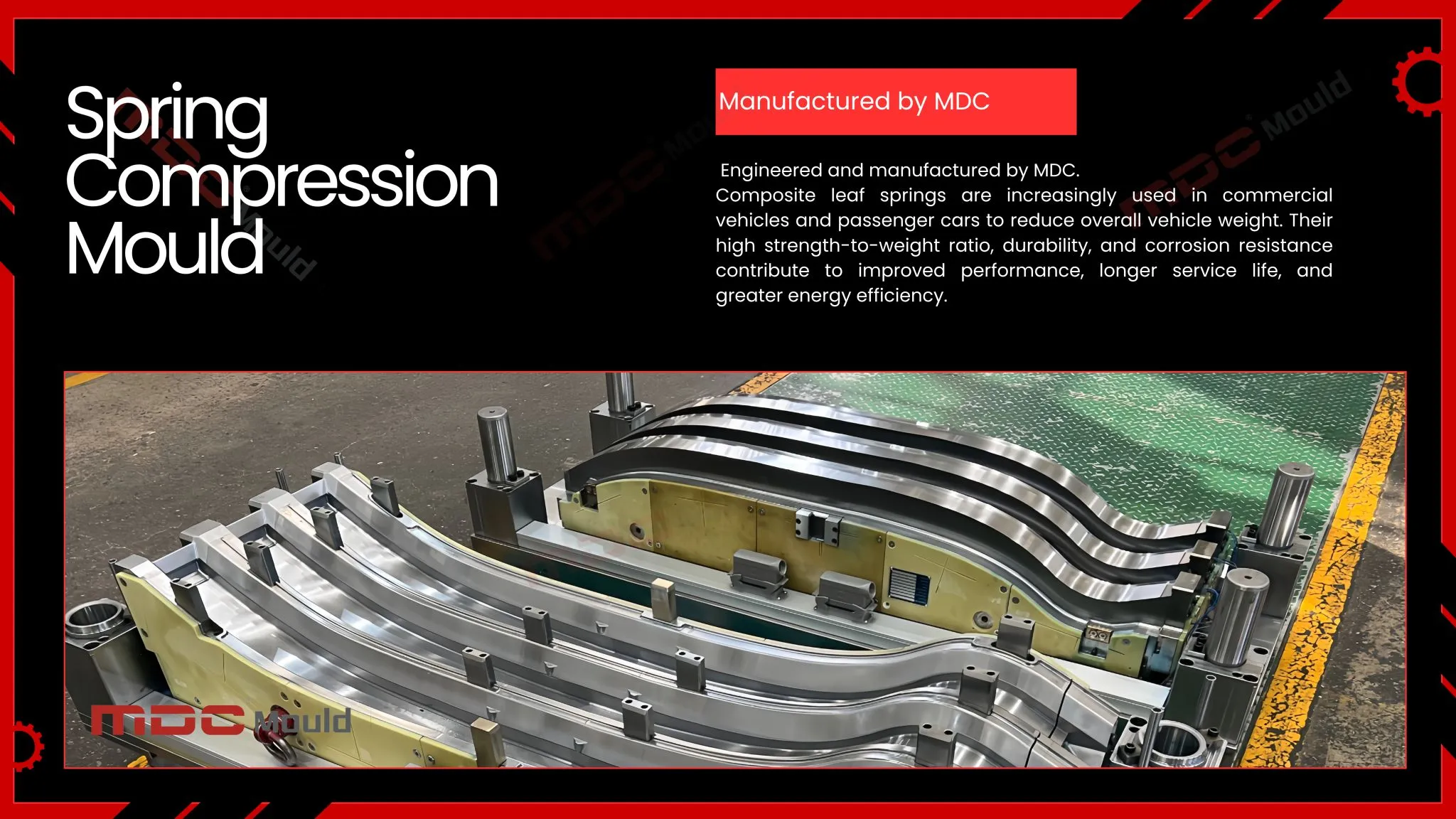
spring compression mould

The Importance of a High-Quality Composite Leaf Spring Mould

The quality of a composite leaf spring is determined not only by the material system but also by the engineering quality of the mould. During compression molding, the mould controls fiber positioning, resin flow, curing temperature, pressure distribution, and final dimensional accuracy.

Even premium composite materials cannot compensate for an improperly designed mould. Uneven heating, insufficient rigidity, or poor cavity accuracy may result in inconsistent thickness, internal voids, fiber distortion, residual stress, or premature product failure.

A precision-engineered composite leaf spring mould helps manufacturers achieve stable production, high repeatability, reduced scrap rates, and consistent mechanical performance throughout long production runs.

Compression Moulding Process for Composite Leaf Springs

Compression molding is one of the most widely adopted manufacturing methods for composite leaf springs because it combines excellent dimensional accuracy with high production efficiency. The process allows reinforced composite materials to cure under controlled temperature and pressure, producing structural components with outstanding mechanical properties.

  1. Composite material preparation
  2. Preform cutting and lay-up
  3. Mould cleaning and release agent application
  4. Material loading into the mould cavity
  5. Hydraulic press closing
  6. Controlled heating and pressure application
  7. Resin curing and laminate consolidation
  8. Controlled cooling
  9. Demoulding
  10. Edge trimming and drilling
  11. Dimensional inspection
  12. Mechanical performance testing

Stable temperature control, balanced pressure distribution, and accurate mould alignment are essential throughout the molding cycle to ensure consistent product quality and long-term production reliability.

Composite Leaf Spring Mould Design Principles

Designing a high-performance composite leaf spring mould requires far more than creating the correct cavity shape. The mould must control fiber consolidation, resin flow, temperature distribution, pressure transmission, and dimensional stability throughout the entire compression molding cycle. Every engineering decision directly affects product performance, manufacturing efficiency, and tooling life.

Because composite leaf springs are structural safety components, manufacturers demand excellent repeatability from every production cycle. A properly engineered mould ensures that each leaf spring meets strict requirements for thickness, curvature, stiffness, and fatigue performance.

Optimized Cavity Geometry

The mould cavity defines the final profile of the composite leaf spring. Smooth transitions, accurate radii, and carefully designed thickness variations help ensure uniform material flow during compression while minimizing internal stress concentrations after curing.

Balanced Pressure Distribution

During compression molding, pressure must be transmitted evenly across the entire laminate. Uneven pressure can lead to resin-rich zones, dry fiber areas, inconsistent thickness, and localized reductions in mechanical strength. Proper mould structure and press alignment help maintain stable pressure throughout the curing cycle.

Structural Rigidity

Composite leaf spring moulds are subjected to significant clamping forces during production. A rigid mould structure minimizes deformation under load, maintains cavity accuracy, and improves long-term production consistency. For large moulds, structural analysis is often performed during the design stage to optimize stiffness without unnecessary weight.

Thermal Expansion Compensation

Repeated heating and cooling cause every mould to expand and contract. Engineers must consider the thermal expansion characteristics of both the tooling material and the composite laminate to maintain dimensional accuracy throughout long production runs.

Heating System Design for Uniform Resin Curing

Temperature control is one of the most critical factors affecting composite leaf spring quality. The heating system must deliver consistent thermal energy across the entire mould surface so that every section of the laminate cures under nearly identical conditions.

If one area of the mould reaches curing temperature earlier than another, the resin may gel prematurely, restricting material flow and creating residual stresses. These stresses can reduce fatigue life and cause dimensional variation after demoulding.

Depending on customer requirements and production capacity, composite leaf spring moulds may use electric cartridge heaters, heating plates, thermal oil circulation, or other controlled heating systems. Regardless of the method, the objective remains the same: maintaining a stable and uniform mould temperature.

  • Uniform resin curing across the entire part
  • Improved dimensional consistency
  • Reduced residual stress and springback
  • Shorter and more predictable production cycles
  • Enhanced mechanical properties
  • Better surface finish and appearance

Tool Steel Selection for Long-Term Production

Tool steel selection has a direct influence on mould durability, machining accuracy, maintenance frequency, and production cost. The optimal material depends on production volume, mould size, curing temperature, and customer quality requirements.

Tool SteelKey AdvantagesRecommended Applications
P20Good machinability and economical costPrototype tooling and medium-volume production
718Higher hardness with excellent polishabilityAutomotive composite moulds
H13Outstanding thermal fatigue resistanceHigh-volume compression molding
S136Excellent corrosion resistance and mirror finishingHigh-precision composite products

In addition to selecting the proper steel grade, appropriate heat treatment is essential for achieving stable hardness, minimizing distortion, and extending mould service life under repeated thermal cycles.

Precision Machining and Surface Finishing

The machining quality of a composite leaf spring mould determines its dimensional accuracy, cavity consistency, and production repeatability. Modern CNC machining technology enables manufacturers to produce complex mould geometries while maintaining tight tolerances throughout the entire cavity.

After rough machining, precision milling, EDM, grinding, and manual fitting are performed to achieve the required accuracy. Surface polishing is then carried out according to product requirements to improve part appearance and facilitate smooth demoulding.

High-quality surface finishing provides several production advantages:

  • Lower demoulding resistance
  • Reduced risk of surface defects
  • Improved resin flow characteristics
  • Enhanced appearance of finished components
  • Reduced mould wear during continuous production

Common Manufacturing Challenges and Engineering Solutions

Although composite leaf spring manufacturing has become increasingly mature, several technical challenges remain. Identifying the root causes of production issues allows engineers to improve process stability while reducing scrap and maintenance costs.

ChallengePrimary CauseEngineering Solution
Thickness VariationUneven pressure or cavity deviationOptimize mould alignment and pressure distribution
Resin-Rich AreasImproper material placementImprove preform design and mould cavity balance
Voids and PorosityEntrapped air during moldingOptimize venting and curing parameters
SpringbackResidual thermal stressImprove temperature uniformity and cooling control
Surface MarksPoor mould finish or contaminationImprove polishing quality and routine mould maintenance
Difficult DemouldingInsufficient draft angle or improper release conditionsOptimize mould design and release agent application

Addressing these challenges during the mould design stage is significantly more effective than correcting defects after production has started. A combination of sound engineering, precision machining, and controlled molding parameters provides the foundation for reliable, high-volume manufacturing.

Applications of Composite Leaf Spring Moulds

As vehicle manufacturers continue to pursue lightweight engineering and improved energy efficiency, composite leaf springs are being adopted across an expanding range of transportation applications. Compared with traditional steel suspension systems, composite leaf springs provide significant weight savings while maintaining excellent structural performance, fatigue resistance, and long-term durability.

Precision composite leaf spring moulds enable manufacturers to produce suspension components with consistent mechanical properties, accurate dimensions, and reliable production repeatability. Today, these moulds are widely used in both conventional and new-energy vehicle manufacturing.

Commercial Trucks

Commercial vehicles require suspension systems capable of carrying heavy loads while operating under demanding road conditions. Composite leaf springs help reduce vehicle weight without sacrificing load capacity, improving fuel efficiency and increasing available payload.

  • Heavy-duty trucks
  • Light commercial vehicles
  • Logistics transport vehicles
  • Municipal service trucks

Passenger Vehicles

Passenger car manufacturers are increasingly replacing steel suspension components with composite alternatives to reduce vehicle mass and improve driving efficiency. Lower unsprung weight also contributes to improved ride comfort and vehicle handling.

  • Passenger cars
  • SUVs
  • Pickup trucks
  • Performance vehicles

Electric Vehicles (EVs)

Every kilogram removed from an electric vehicle contributes to improved energy efficiency and extended driving range. Composite leaf springs support lightweight vehicle architecture while maintaining the structural reliability required for long-term operation.

  • Battery electric vehicles
  • Electric delivery vans
  • Electric buses
  • Commercial EV platforms

Specialty Vehicles

Composite suspension technology is also suitable for agricultural machinery, military vehicles, off-road equipment, and specialty transportation systems where corrosion resistance, durability, and weight reduction are equally important.

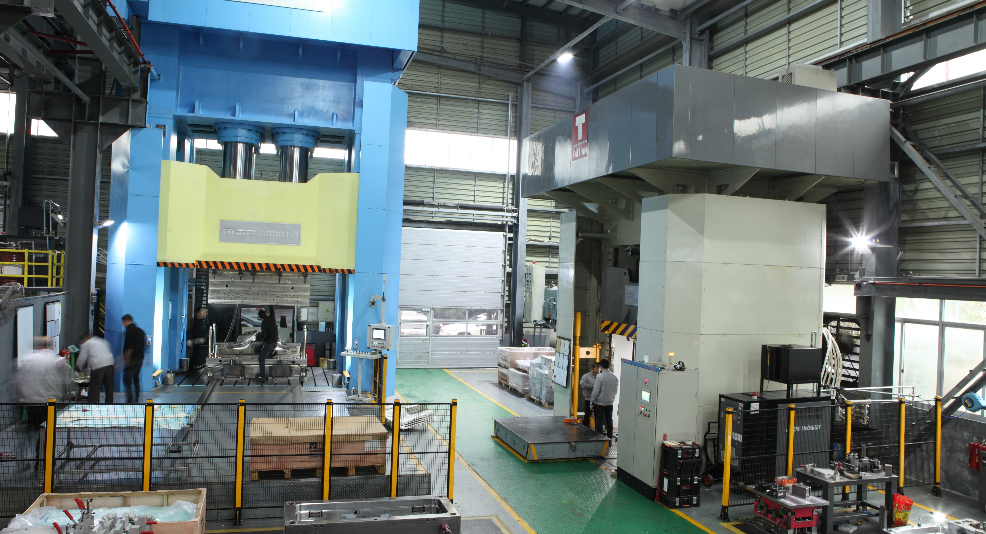
compression-mould-machine

How MDC Manufactures Composite Leaf Spring Moulds

Manufacturing a high-quality composite leaf spring mould requires a combination of engineering expertise, precision machining, and rigorous quality management. At MDC, every mould is developed with the objective of delivering stable production, long service life, and consistent product quality throughout thousands of molding cycles.

From the initial design review to final mould testing, every stage follows standardized engineering procedures to ensure reliable performance in demanding production environments.

Engineering Evaluation

Each project begins with a detailed analysis of the customer’s product drawings, composite material selection, production volume, and molding process. Design for Manufacturability (DFM) reviews help optimize mould structure before manufacturing starts.

Precision Machining

Advanced CNC machining centers are used to manufacture mould components with high dimensional accuracy. Precision milling, EDM, grinding, and manual fitting ensure that every cavity meets strict engineering requirements.

Heating System Integration

Heating channels are carefully designed to provide uniform temperature distribution across the mould surface. Balanced thermal performance improves curing consistency while reducing residual stress and dimensional variation.

Assembly and Trial Molding

Before delivery, moulds are assembled, inspected, and trial-tested to verify dimensional accuracy, product appearance, and molding performance. Any necessary adjustments are completed before shipment to help customers achieve a faster production start-up.

Quality Control Throughout the Manufacturing Process

Reliable quality control is essential for producing precision compression moulds. At MDC, inspection is integrated into every manufacturing stage rather than being limited to the final acceptance process.

Manufacturing StageQuality Control Focus
Raw Material InspectionVerify tool steel grade, hardness, and material certification
CNC MachiningMonitor dimensional accuracy and machining tolerances
Heat TreatmentControl hardness and minimize thermal distortion
Component AssemblyCheck alignment, fitting accuracy, and structural integrity
Surface FinishingInspect polishing quality and cavity appearance
Trial MoldingValidate molding performance and finished part quality
Final InspectionConfirm dimensions, documentation, and customer specifications

This systematic quality management approach helps reduce production risks, improve mould reliability, and provide customers with tooling that performs consistently under continuous manufacturing conditions.

Why Choose MDC for Composite Leaf Spring Mould Manufacturing?

Selecting the right mould manufacturer is a key factor in the success of any composite leaf spring project. Beyond machining capability, an experienced tooling partner should understand composite materials, compression molding technology, tooling durability, and the production challenges associated with structural automotive components.

With extensive experience in compression mould and composite mould manufacturing, MDC supplies customized tooling solutions for customers worldwide. Every project is developed with careful attention to engineering accuracy, production efficiency, and long-term mould performance.

  • Customized mould design based on customer requirements
  • Professional DFM analysis and engineering support
  • Extensive experience in composite compression molding
  • High-speed CNC machining and precision EDM
  • Optimized heating and venting system design
  • Strict dimensional inspection and quality management
  • Prototype, pilot, and mass-production tooling solutions
  • Reliable technical communication and global project support
  • Comprehensive one-stop composite mould manufacturing services

Whether you are developing lightweight suspension systems for commercial vehicles or advanced composite components for passenger cars, MDC is committed to delivering precision mould solutions that help improve manufacturing efficiency, product consistency, and long-term production reliability.

Why Composite Leaf Springs Are the Future of Lightweight Suspension Systems

The global automotive industry is undergoing a fundamental transformation driven by vehicle electrification, stricter emissions regulations, and increasing demand for lightweight engineering. Every kilogram removed from a vehicle contributes to improved fuel economy, lower emissions, or extended driving range. As a result, manufacturers are replacing conventional steel components with advanced composite materials wherever practical.

Among suspension components, composite leaf springs represent one of the most effective opportunities for weight reduction. Compared with traditional multi-leaf steel springs, composite designs combine lower mass with outstanding fatigue resistance, corrosion resistance, and design flexibility, making them increasingly attractive for both commercial and passenger vehicles.

ComparisonComposite Leaf SpringTraditional Steel Leaf Spring
WeightUp to 60–70% lighterHeavier
Corrosion ResistanceExcellentRequires protective coating
Fatigue PerformanceExcellent under repeated loadingGood but susceptible to fatigue cracking
Noise & VibrationBetter vibration dampingHigher noise transmission
MaintenanceLower maintenance requirementsRegular inspection and corrosion protection
Design FlexibilityHighLimited by steel forming

These advantages make composite leaf springs particularly suitable for electric vehicles, commercial trucks, buses, and specialty vehicles where lightweight construction directly improves operating efficiency and payload capacity.

Frequently Asked Questions

What is a composite leaf spring mould?

A composite leaf spring mould is a precision compression mould used to manufacture fiber-reinforced composite leaf springs under controlled temperature and pressure. It determines the final shape, thickness, dimensional accuracy, and mechanical consistency of the finished suspension component.

Which materials are used to manufacture composite leaf springs?

Composite leaf springs are commonly produced using glass fiber, carbon fiber, or hybrid fiber reinforcements combined with thermosetting resin systems such as epoxy, vinyl ester, or polyester resin.

Why is compression molding used for composite leaf springs?

Compression molding provides excellent fiber consolidation, high dimensional accuracy, short production cycles, and consistent product quality, making it one of the most efficient manufacturing methods for structural composite suspension components.

How does mould quality affect leaf spring performance?

A precision mould ensures uniform pressure, balanced curing temperatures, accurate laminate thickness, and consistent fiber distribution. These factors directly influence fatigue life, load capacity, dimensional stability, and long-term reliability.

What tool steels are commonly used for composite leaf spring moulds?

P20, 718, H13, and S136 tool steels are widely used depending on production volume, curing temperature, polishing requirements, and expected mould service life.

Which industries use composite leaf spring moulds?

Composite leaf spring moulds are widely used in commercial vehicles, passenger cars, electric vehicles, buses, agricultural machinery, military vehicles, and specialty transportation equipment.

Can composite leaf spring moulds be customized?

Yes. Every mould can be customized according to the customer’s product geometry, composite material, production capacity, press specifications, and quality requirements.

Why choose MDC for composite leaf spring mould manufacturing?

MDC combines engineering expertise, precision CNC machining, optimized heating system design, strict quality control, and extensive experience in compression mould manufacturing to deliver reliable tooling solutions for global customers.

Conclusion

As vehicle manufacturers continue to pursue lightweight engineering, higher energy efficiency, and improved durability, composite leaf springs are becoming an increasingly important alternative to conventional steel suspension systems. Their superior strength-to-weight ratio, corrosion resistance, fatigue performance, and design flexibility make them an ideal solution for modern commercial vehicles, passenger cars, and electric vehicle platforms.

Achieving consistent performance from these advanced components depends not only on high-quality composite materials but also on precision-engineered tooling. A well-designed composite leaf spring mould ensures balanced pressure distribution, uniform resin curing, accurate dimensional control, and reliable production throughout the entire manufacturing process.

At MDC, we are committed to providing high-performance compression moulds for composite leaf spring applications. From DFM analysis and mould design to precision machining, assembly, trial molding, and technical support, our experienced engineering team works closely with customers to develop tooling solutions that improve production efficiency, reduce manufacturing costs, and support long-term product quality.

Whether you are developing next-generation suspension systems for electric vehicles or high-strength composite components for commercial transportation, MDC delivers customized mould solutions engineered for precision, durability, and reliable mass production.

Press Tool: Complete Guide to Press Tool Design, Manufacturing and Composite Tooling

Discover professional compression press tools for advanced composite molding. Elevate your production with custom SMC, BMC, and CFRP press tooling from MDC.

Modern manufacturing depends on precision tooling to produce components with consistent dimensions, reliable mechanical performance, and high production efficiency. Among the various types of industrial tooling, the press tool plays a critical role in shaping materials through controlled pressure, making it an indispensable solution for industries ranging from automotive and electrical equipment to aerospace and advanced composite manufacturing.

Although the term press tool is often associated with sheet metal stamping, it also encompasses tooling used in compression molding, composite manufacturing, and thermoset material processing. As lightweight materials such as SMC, BMC, carbon fiber, and glass fiber reinforced composites become increasingly important, precision-engineered press tools are essential for producing high-performance parts with excellent dimensional accuracy and surface quality.

This guide explores the fundamentals of press tool design, manufacturing technologies, tooling materials, production processes, common applications, and the engineering principles behind high-quality composite press tooling. Whether you are developing a new product or selecting a reliable tooling partner, understanding these factors will help improve manufacturing efficiency and long-term production reliability.

What Is a Press Tool?

A press tool is a precision-engineered device that forms, shapes, compresses, or cuts materials by applying controlled force through a mechanical or hydraulic press. The tool determines the final geometry, dimensional accuracy, surface finish, and repeatability of every manufactured component.

Depending on the production process, press tools can be designed for metal forming, composite compression molding, thermoset processing, or other specialized manufacturing operations. While their applications differ, all press tools share the same objective: converting raw materials into finished products with high precision and consistent quality.

For composite manufacturing, press tools are commonly used to mold Sheet Molding Compound (SMC), Bulk Molding Compound (BMC), carbon fiber prepregs, and other fiber-reinforced materials under carefully controlled temperature and pressure conditions.

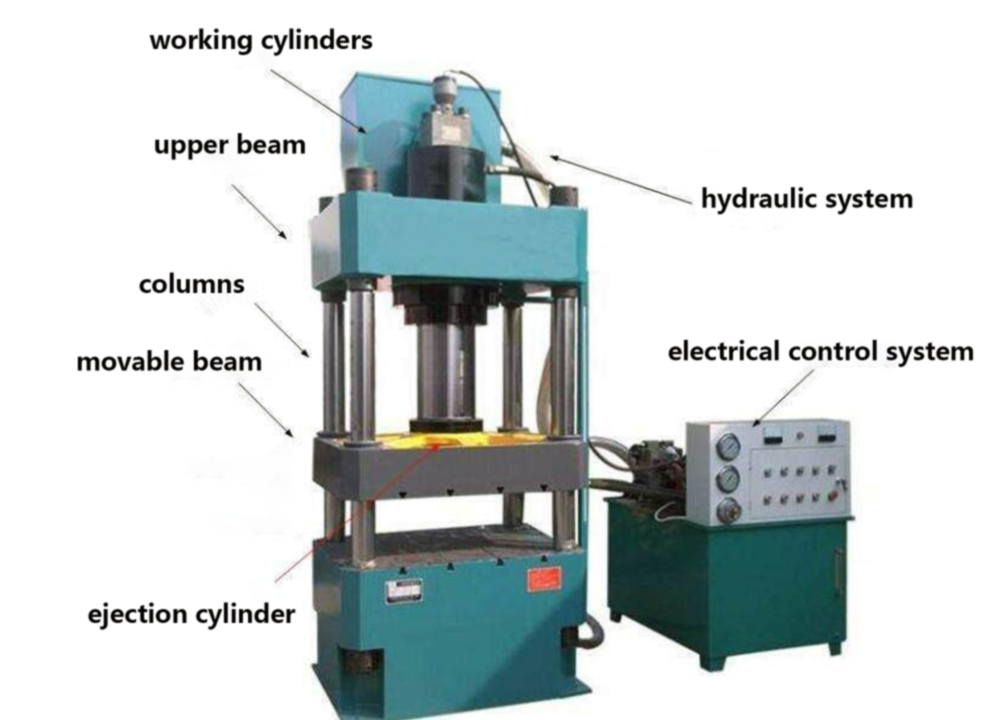
Hydraulic press structure

How Does a Press Tool Work?

The operation of a press tool follows a systematic manufacturing sequence in which raw material is positioned inside the tool cavity before pressure is applied by the press machine. During the forming cycle, the tool controls material flow, maintains dimensional accuracy, and ensures consistent product quality.

  • Product and tooling design
  • Raw material preparation
  • Material loading into the mold cavity
  • Press closing
  • Controlled pressure application
  • Heating and material forming (when required)
  • Material curing or shaping
  • Cooling cycle
  • Press opening
  • Part removal
  • Trimming and finishing
  • Final quality inspection

Every stage of this process influences product consistency. Accurate tool alignment, balanced pressure distribution, controlled temperature, and reliable venting all contribute to producing defect-free components with stable mechanical properties.

Types of Press Tools

Press tools can be classified according to their manufacturing processes and intended applications. Selecting the appropriate tooling solution depends on the material being processed, production volume, product complexity, and required dimensional accuracy.

Press Tool TypeMain FunctionTypical Applications
Compression Press ToolForms composite materials under heat and pressureSMC, BMC, carbon fiber, FRP components
Stamping Press ToolCuts and forms sheet metalAutomotive metal parts and electrical components
Progressive Press ToolPerforms multiple operations in one production cycleHigh-volume precision metal components
Transfer Press ToolMoves parts automatically between forming stationsComplex metal products
Composite Press ToolMolds advanced composite materialsLightweight structural components

Although different tooling systems serve different manufacturing sectors, composite compression press tools have become increasingly important as industries adopt lightweight materials to improve product performance and reduce energy consumption.

Compression Press Tools for Composite Manufacturing

Among all categories of press tooling, compression press tools are particularly important in composite manufacturing. They are designed to shape fiber-reinforced materials by applying precisely controlled pressure and temperature, allowing thermosetting resins to cure into rigid structural components.

Compared with conventional metal forming, compression molding requires careful control of resin flow, fiber distribution, venting, heating balance, and curing cycles. Consequently, the engineering quality of the press tool has a direct impact on product strength, appearance, dimensional stability, and production efficiency.

Compression press tools are widely used for manufacturing automotive battery covers, electrical enclosures, truck body panels, sanitary ware, industrial housings, railway interior components, and many other advanced composite products.

Press Tool Design Principles

An excellent press tool is not defined solely by machining accuracy. Successful tooling design requires a comprehensive understanding of material behavior, pressure distribution, thermal expansion, resin flow, structural rigidity, and long-term production stability. Every engineering decision made during the design stage directly affects cycle time, product quality, maintenance costs, and mold service life.

For composite compression molding, press tool design becomes even more critical because thermosetting materials must flow, consolidate, and cure simultaneously inside a closed mold cavity. Poor tooling design cannot be compensated for by simply increasing molding pressure or extending curing time.

Balanced Pressure Distribution

Uniform pressure ensures that composite materials flow evenly throughout the cavity. Uneven pressure distribution may lead to incomplete filling, thickness variation, resin-rich areas, excessive flash, or localized fiber distortion. Proper cavity design and platen parallelism help maintain consistent pressure across the entire molding surface.

Thermal Balance Design

Temperature consistency is one of the most important factors in compression molding. Different curing rates across the mold surface can create residual stress, dimensional instability, and inconsistent mechanical performance. Heating channels should therefore be arranged to minimize temperature variation and ensure uniform curing throughout the part.

Structural Rigidity

Large composite molds are subjected to significant clamping forces during production. Insufficient mold rigidity may result in deformation, cavity misalignment, excessive wear, and poor repeatability. Finite element analysis (FEA) is often used during mold development to optimize structural strength while controlling overall tool weight.

Efficient Venting

Air and volatile gases generated during molding must escape efficiently from the cavity. Proper venting reduces voids, pinholes, burn marks, and incomplete filling while improving laminate consolidation and surface finish.

Reliable Demolding

Well-designed draft angles, ejector systems, and parting lines minimize demolding resistance and protect finished components from surface damage. Reliable demolding also shortens production cycles and extends mold service life.

Tool Steel Selection for Press Tools

Selecting the appropriate tooling material is essential for achieving long-term production stability. Different tool steels provide different combinations of hardness, toughness, thermal conductivity, polishability, and wear resistance. Material selection should always match the expected production volume and molding conditions.

MaterialMain CharacteristicsTypical Applications
P20Good machinability and economical costPrototype tooling and medium-volume production
718Higher hardness and improved polishing performanceAutomotive composite molds
H13Excellent hot-strength and thermal fatigue resistanceHigh-temperature compression molds
S136Superior corrosion resistance and mirror finish capabilityHigh-gloss composite products

Beyond material selection, heat treatment also plays a significant role in determining tool performance. Proper hardening and tempering improve wear resistance, reduce distortion during production, and extend the operational life of the press tool.

Heating System Design

A well-designed heating system is fundamental to successful composite molding. It determines how efficiently heat is transferred into the material and directly affects resin flow, curing speed, dimensional stability, and surface quality.

Uneven temperature distribution often results in inconsistent curing. Some areas of the part may become over-cured while others remain under-cured, leading to warpage, residual stress, or reduced mechanical properties.

Modern composite press tools commonly use cartridge heaters, electric heating plates, thermal oil circulation, or steam heating, depending on production requirements. Regardless of the heating method, maintaining consistent mold surface temperature is the primary objective.

  • Improves curing consistency
  • Reduces cycle time
  • Minimizes internal stress
  • Enhances dimensional accuracy
  • Produces better surface quality

Venting Design for Composite Press Tools

Effective venting is often underestimated during mold design, yet it plays a crucial role in composite part quality. During compression molding, trapped air and volatile gases generated by the resin system must escape from the mold cavity before curing is completed.

Poor venting can create defects such as trapped air pockets, porosity, pinholes, incomplete filling, and excessive flash. These defects not only reduce product appearance but may also compromise structural integrity.

Engineers optimize vent locations according to part geometry, material flow direction, and cavity filling characteristics. Proper vent dimensions allow gases to escape while preventing excessive resin leakage.

Press Tool Manufacturing Process

Manufacturing a high-quality press tool involves far more than machining steel blocks. Each production stage contributes to the final accuracy, durability, and reliability of the tooling.

  1. Product drawing evaluation
  2. Design for Manufacturability (DFM) analysis
  3. 3D mold design
  4. Tool steel selection
  5. Rough CNC machining
  6. Heat treatment
  7. Semi-finish machining
  8. Electrical Discharge Machining (EDM)
  9. Grinding and precision fitting
  10. Surface polishing
  11. Mold assembly
  12. Trial pressing and process validation
  13. Dimensional inspection
  14. Final approval and shipment

Strict quality control throughout every manufacturing stage helps ensure that the finished press tool delivers consistent performance during long production runs while minimizing maintenance requirements.

Precision Machining and Quality Control

The manufacturing accuracy of a press tool directly determines the dimensional consistency of molded products. High-speed CNC machining, precision EDM, grinding, and coordinate measuring inspection work together to produce tooling capable of meeting demanding industrial tolerances.

Quality control should not be limited to the final inspection. Instead, dimensional verification throughout the machining process allows deviations to be detected early, reducing rework and improving manufacturing efficiency.

Before delivery, comprehensive trial pressing verifies cavity accuracy, product appearance, assembly performance, and molding consistency. This validation process helps customers begin production with greater confidence while minimizing commissioning time.

Common Press Tool Problems and Engineering Solutions

Even a well-designed press tool may experience quality issues if tooling design, machining accuracy, process parameters, or maintenance are not properly controlled. Understanding the root causes of these problems helps manufacturers improve production stability, reduce downtime, and extend tool service life.

Rather than treating symptoms after defects occur, experienced tooling engineers focus on eliminating potential problems during the design and manufacturing stages. Proper material selection, balanced heating, accurate machining, and preventive maintenance all contribute to long-term production reliability.

ProblemPossible CauseRecommended Solution
Excessive FlashPoor mold sealing, insufficient clamping force, or worn parting surfacesImprove machining accuracy, repair sealing surfaces, and optimize pressing force.
Uneven Product ThicknessUnbalanced pressure distribution or mold misalignmentVerify mold parallelism and optimize cavity structure.
Surface DefectsPoor polishing, trapped air, or contaminated mold surfacesImprove polishing quality, optimize venting, and maintain clean tooling surfaces.
Incomplete FillingInsufficient material flow, low molding temperature, or inadequate pressureAdjust molding parameters and optimize runner or cavity design where applicable.
Premature Tool WearImproper tool steel selection or inadequate heat treatmentSelect suitable tool steel and apply appropriate hardening processes.
Difficult DemoldingInsufficient draft angle or poor ejector designOptimize draft angles, ejector locations, and surface finishing.
Thermal CrackingRepeated heating and cooling cycles creating thermal fatigueUse heat-resistant tool steel and maintain uniform mold temperature.

Many of these issues can be prevented before production begins. Early engineering review and proper process validation significantly reduce maintenance costs while improving overall manufacturing efficiency.

Applications of Press Tools

Press tools are widely used across modern manufacturing industries because they enable high-volume production with excellent repeatability and dimensional accuracy. As lightweight materials continue replacing traditional metals, composite press tools have become increasingly important in advanced industrial applications.

Automotive Manufacturing

Automotive manufacturers use press tools to produce structural components, exterior body panels, battery enclosures, electrical housings, and lightweight composite assemblies. Compression press tools are particularly suitable for SMC and carbon fiber parts that require high strength and reduced vehicle weight.

  • EV battery covers
  • Front-end modules
  • Truck body panels
  • Roof systems
  • Door inner structures
  • Engine covers
  • Underbody protection panels

Electrical Infrastructure

SMC and BMC press tools are widely used to manufacture electrical enclosures, meter boxes, switchgear housings, transformer components, cable protection systems, and other insulation products that require excellent electrical performance and corrosion resistance.

Building and Sanitary Products

Composite press tools support the production of bathroom products, wall panels, decorative ceilings, water tanks, manhole covers, and architectural components that combine durability with low maintenance requirements.

Rail Transportation

Railway manufacturers increasingly adopt composite materials to reduce vehicle weight and improve energy efficiency. Press tools are used to produce interior panels, equipment housings, seat structures, roof components, and various structural parts for modern rail systems.

Renewable Energy

Composite press tooling is also applied in wind power, solar energy, hydrogen infrastructure, and other renewable energy industries where corrosion resistance, dimensional stability, and lightweight construction are essential.

Industrial Equipment

Industrial machinery manufacturers use precision press tools to produce equipment covers, machine housings, automation system components, and structural composite parts designed for demanding operating environments.

compression-mould-machine

Why Precision Press Tools Improve Manufacturing Efficiency

Many manufacturers evaluate tooling primarily based on purchase price. However, the true value of a high-quality press tool becomes evident throughout its production life. A precision-engineered tool reduces scrap rates, shortens cycle times, minimizes maintenance, and improves overall equipment effectiveness (OEE).

Although the initial investment may be higher, well-designed tooling often delivers significantly lower manufacturing costs over thousands of production cycles through improved stability and reduced downtime.

  • Higher dimensional consistency
  • Lower reject rates
  • Reduced flash and secondary finishing
  • Improved surface quality
  • Longer mold service life
  • Lower maintenance frequency
  • More stable production scheduling
  • Lower total manufacturing cost

For manufacturers producing high-volume composite components, tooling quality directly influences profitability, customer satisfaction, and long-term production competitiveness.

Why Choose MDC for Custom Press Tool Manufacturing

MDC specializes in designing and manufacturing precision press tools for composite molding applications. With extensive experience in SMC, BMC, carbon fiber, and other advanced composite materials, our engineering team develops tooling solutions that balance precision, durability, and production efficiency.

Every project begins with a thorough review of the customer’s product design, material selection, production targets, and molding process. This engineering-first approach helps identify potential risks early and supports efficient mold development from concept to mass production.

Our manufacturing capabilities include high-speed CNC machining, EDM, precision grinding, mirror polishing, mold assembly, trial molding, and comprehensive dimensional inspection. Strict quality control is maintained throughout every stage to ensure reliable tooling performance and long service life.

MDC Advantages

  • Professional DFM and tooling engineering support
  • Extensive experience in compression mold manufacturing
  • High-precision CNC machining equipment
  • Optimized heating and venting system design
  • Strict dimensional inspection and quality management
  • Prototype, pilot production, and mass-production tooling solutions
  • Reliable global project delivery and technical support

Whether your project involves automotive lightweight structures, electrical insulation products, industrial composite components, or customized molding solutions, MDC is committed to delivering press tools that support consistent quality and efficient manufacturing.

Press Tool vs Mold: What’s the Difference?

The terms press tool and mold are sometimes used interchangeably, but they do not always describe the same type of tooling. Understanding the difference is important when selecting a manufacturing process or communicating technical requirements with suppliers.

A press tool is a broader term that refers to tooling installed in a press machine to shape, form, compress, or cut materials. Depending on the manufacturing process, a press tool may be designed for metal stamping, blanking, punching, bending, or composite compression molding.

A mold, on the other hand, is specifically designed to create the final shape of a product by forming material inside a cavity. Molds are commonly used for injection molding, compression molding, transfer molding, resin transfer molding (RTM), and other composite manufacturing processes.

Comparison ItemPress ToolMold
Main PurposeForming, cutting, bending or compressing materialsCreating a finished product inside a mold cavity
Typical MaterialsMetal sheet, composites, thermoset materialsPlastic, rubber, composites, thermosets
Manufacturing ProcessPress formingMolding process
EquipmentMechanical or hydraulic pressInjection machine, compression press, RTM equipment
Typical IndustriesMetalworking and composite manufacturingPlastic, rubber and composite manufacturing

For composite manufacturing, the distinction becomes less obvious because a compression mold is installed in a hydraulic press and therefore also functions as a composite press tool. In practice, manufacturers often use both terms depending on industry conventions and regional preferences.

How to Choose the Right Press Tool Manufacturer

Selecting a press tool supplier involves much more than comparing quotations. The performance of the tooling directly influences production efficiency, product quality, maintenance requirements, and the overall cost of manufacturing throughout the life of the project.

Before placing an order, manufacturers should evaluate both the technical capabilities and the engineering support offered by the tooling supplier.

Engineering Experience

A qualified manufacturer should understand not only tool manufacturing but also material behavior, molding processes, and production optimization. Early engineering support often helps eliminate potential manufacturing problems before machining begins.

Manufacturing Equipment

Modern CNC machining centers, EDM equipment, precision grinding machines, and coordinate measuring systems enable higher machining accuracy and better tooling consistency. Advanced equipment also improves production efficiency and reduces lead time.

Quality Control

Reliable quality management includes incoming material inspection, in-process dimensional verification, assembly inspection, trial molding, and final acceptance testing. Consistent inspection procedures ensure that every tool meets customer specifications before shipment.

Project Support

An experienced tooling partner should provide support throughout the project, including DFM analysis, tooling optimization, production trials, technical documentation, and after-sales assistance. Continuous engineering communication helps customers achieve stable production more quickly.

Frequently Asked Questions

What is a press tool?

A press tool is a precision tool used with a mechanical or hydraulic press to form, shape, compress, or cut materials into finished components. Depending on the application, it may be designed for metal forming or composite molding.

What is the difference between a press tool and a mold?

A press tool is a general term covering tooling used in press machines, while a mold specifically forms materials inside a cavity. In composite manufacturing, a compression mold is also considered a type of press tool.

Which materials are commonly used to manufacture press tools?

Common tooling materials include P20, 718, H13, and S136 tool steels, as well as aluminum alloys for prototype tooling. Material selection depends on production volume, operating temperature, and required service life.

Why is heating system design important?

A balanced heating system ensures uniform resin curing, reduces residual stress, improves dimensional accuracy, and shortens production cycles during composite molding.

How long does a press tool last?

Tool life depends on tooling material, heat treatment, maintenance, production conditions, and manufacturing quality. Properly maintained steel tools can remain productive through many thousands of production cycles.

Can press tools be customized?

Yes. Press tools are commonly customized according to part geometry, production volume, material type, surface finish requirements, and customer-specific manufacturing processes.

Which industries use composite press tools?

Composite press tools are widely used in automotive, electrical infrastructure, aerospace, railway transportation, renewable energy, sanitary ware, industrial equipment, and construction industries.

What should be considered when selecting a press tool supplier?

Engineering capability, machining accuracy, tooling materials, quality management, project experience, trial molding capability, and technical support are all important factors when selecting a reliable tooling manufacturer.

Conclusion

Press tools are fundamental to modern manufacturing, enabling the efficient production of high-quality components with excellent dimensional consistency and repeatability. As industries continue to adopt lightweight composite materials, precision press tooling has become increasingly important for achieving stable production, shorter cycle times, and superior product performance.

For composite applications, successful tooling requires far more than precision machining. It depends on optimized structural design, balanced heating systems, effective venting, appropriate tool steel selection, and comprehensive engineering expertise. Every aspect of tool development contributes to manufacturing efficiency and long-term production reliability.

With extensive experience in compression molds and composite press tools, MDC provides customized tooling solutions for SMC, BMC, carbon fiber, and other advanced composite materials. From initial engineering consultation and DFM analysis to precision machining, trial molding, and technical support, MDC is committed to helping customers improve manufacturing performance through reliable, high-quality press tooling solutions.