Contents
- Why Modern Manufacturing Requires More Than a Compression Mold
- High-Precision Compression Mold Manufacturing
- Cooling System Solutions
- Checking Fixtures
- Engineering Support
- Quality Control
- Industries We Serve
- FAQ
As global industries continue moving toward lightweight engineering, high-performance composite materials, and intelligent manufacturing, the expectations placed on compression mold suppliers have evolved dramatically. Today, manufacturers are no longer looking for a company that simply machines a mold. Instead, they seek an experienced engineering partner capable of delivering complete manufacturing solutions that improve production efficiency, reduce development risks, and shorten product launch cycles.
At MDC, we believe a successful compression molding project begins long before the first mold is machined and continues well beyond mold delivery. Our expertise extends across every stage of the manufacturing process—from product feasibility analysis and mold engineering to cooling system optimization, checking fixtures, mold trials, technical support, and production validation.
Rather than functioning solely as a compression mold manufacturer, MDC provides integrated engineering services designed to help customers achieve stable production, consistent product quality, and lower overall manufacturing costs. By combining precision mold manufacturing with comprehensive supporting services, we enable customers worldwide to simplify supplier management while improving operational efficiency.
Whether your project involves SMC (Sheet Molding Compound), BMC (Bulk Molding Compound), GMT composites, carbon fiber components, fiberglass reinforced plastics, or other advanced composite materials, our experienced engineering team delivers customized one-stop compression molding solutions tailored to your production objectives.
Why Modern Manufacturing Requires More Than a Compression Mold
Traditional mold suppliers generally complete their responsibilities once a mold has been manufactured and delivered. However, modern manufacturing environments have become significantly more complex. Manufacturers must simultaneously optimize production efficiency, dimensional consistency, material utilization, labor costs, energy consumption, and overall equipment effectiveness.
These challenges cannot be solved through precision machining alone. Even a perfectly manufactured mold may experience unstable production if supporting engineering systems have not been properly designed.
Successful compression molding depends on the interaction of numerous engineering disciplines, including:
- Product structural design
- Material flow behavior
- Compression mold engineering
- Heating and cooling efficiency
- Fiber distribution control
- Venting system optimization
- Demolding performance
- Dimensional inspection methods
- Production process validation
- Long-term mold maintenance planning
Every one of these factors directly influences product quality, cycle time, and manufacturing cost. This is why leading manufacturers increasingly prefer suppliers capable of providing integrated engineering support rather than standalone tooling.
At MDC, our objective is to become your long-term manufacturing partner by integrating advanced mold production with value-added engineering services that optimize every stage of your project.
Complete Compression Molding Solutions Under One Roof
Managing multiple suppliers often creates unnecessary communication barriers, extended lead times, and inconsistent quality standards. Engineering modifications may require coordination between mold manufacturers, cooling system suppliers, inspection fixture manufacturers, and production teams, significantly increasing project complexity.
MDC simplifies this process by offering a comprehensive one-stop solution that combines every essential service required for successful compression molding production.
Our integrated capabilities include:
- Compression mold design
- Custom mold manufacturing
- DFM (Design for Manufacturability) analysis
- CAE engineering support
- Cooling system optimization
- Heating system design
- Checking fixture manufacturing
- Mold assembly and fitting
- Surface polishing and texturing
- Chrome plating coordination
- Trial molding and process validation
- Dimensional inspection
- Technical consultation
- After-sales engineering support
This integrated approach minimizes project risks while allowing customers to focus on product innovation instead of supplier coordination.
High-Precision Compression Mold Manufacturing
The mold remains the heart of every compression molding project. High-quality tooling determines not only product dimensions but also production efficiency, mold longevity, repeatability, and manufacturing stability.
MDC manufactures precision compression molds for a broad range of composite applications across automotive, construction, electrical, sanitary ware, energy storage, water treatment, and industrial equipment industries.
Our tooling supports numerous composite materials, including:
- SMC (Sheet Molding Compound)
- BMC (Bulk Molding Compound)
- FRP (Fiber Reinforced Plastic)
- GMT (Glass Mat Thermoplastic)
- LFT (Long Fiber Thermoplastic)
- Carbon Fiber Composite
- Glass Fiber Composite
- Thermoset Composite Materials
Each mold is manufactured using advanced CNC machining centers, high-speed milling technology, EDM processing, precision grinding, and rigorous inspection procedures to ensure exceptional dimensional accuracy and long service life.
Throughout mold development, our engineering team carefully evaluates:
- Cavity layout optimization
- Uniform cavity pressure distribution
- Material flow balance
- Venting system efficiency
- Runner and overflow design
- Demolding performance
- Maintenance accessibility
- Future production scalability
These engineering considerations enable customers to achieve reliable production performance throughout the entire life cycle of the mold.
Engineering Better Cooling Systems for Faster Production
Cooling system design is one of the most underestimated factors affecting compression molding productivity. While machining precision is critical, thermal management often determines whether a production line achieves maximum efficiency.
An improperly designed cooling system can create temperature variations across the mold cavity, leading to uneven curing, residual internal stresses, dimensional instability, excessive shrinkage, surface defects, and longer production cycles.
Rather than treating cooling channels as secondary features, MDC incorporates thermal engineering into the earliest stages of mold design.
Our engineers optimize every aspect of cooling performance, including:
- Cooling channel layout
- Channel diameter selection
- Cooling circuit balancing
- Distance between cooling channels and cavity surfaces
- Heat transfer efficiency
- Water flow distribution
- Temperature uniformity
- Cycle time reduction
Well-designed cooling systems help manufacturers reduce curing time while maintaining stable dimensional accuracy and consistent mechanical properties across every production cycle.
For high-volume production environments, even small improvements in cooling efficiency can generate substantial long-term cost savings through increased productivity and reduced energy consumption.
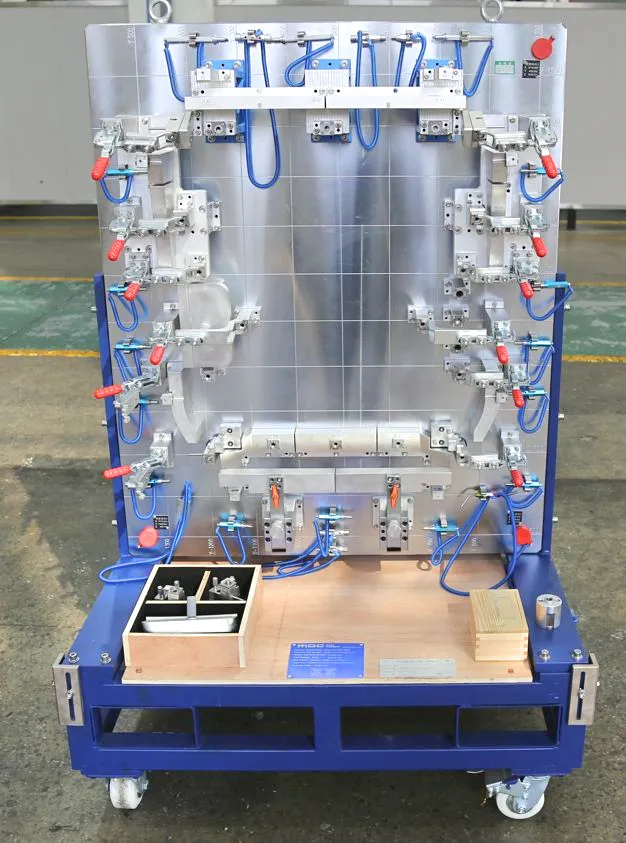
Custom Checking Fixtures for Accurate Dimensional Inspection
Manufacturing a precision compression mold is only the first step toward producing high-quality composite parts. To ensure every molded component consistently meets engineering drawings and customer specifications, reliable dimensional inspection is equally important.
For industries such as automotive, electrical equipment, transportation, construction, and energy storage, dimensional consistency directly affects product assembly, structural integrity, sealing performance, and long-term reliability. Even minor dimensional deviations can lead to costly rework, assembly issues, or field failures.
To help customers establish efficient quality control systems, MDC designs and manufactures customized checking fixtures that match each molded product and production requirement.
Unlike conventional measuring methods that rely heavily on operator experience, checking fixtures provide fast, repeatable, and standardized inspection procedures suitable for both sample validation and mass production.
Typical Inspection Items Include
- Overall product dimensions
- Critical functional dimensions
- Hole locations and mounting positions
- Flatness and surface profile verification
- Assembly interface inspection
- Reference datum positioning
- Part deformation analysis
- Repeatability verification
By integrating checking fixtures into the production process, manufacturers can significantly reduce inspection time, improve measurement consistency, and quickly identify production deviations before they affect downstream assembly operations.
Engineering Support Begins Before Mold Manufacturing
One of the most common reasons for project delays is that manufacturability issues are discovered only after mold production has already begun. Design modifications at this stage often increase costs, extend lead times, and introduce unnecessary engineering risks.
At MDC, engineering support begins long before steel is cut.
Our Design for Manufacturability (DFM) process evaluates product geometry, molding feasibility, material characteristics, structural strength, and production efficiency during the earliest project stages.
This proactive engineering approach allows potential manufacturing challenges to be identified and resolved before mold design is finalized.
Our DFM Analysis Covers
- Part geometry evaluation
- Draft angle optimization
- Wall thickness consistency
- Rib and boss design
- Material flow analysis
- Potential air trap locations
- Fiber orientation considerations
- Demolding feasibility
- Shrinkage prediction
- Parting line optimization
- Flash control strategy
- Production efficiency improvement
Early engineering collaboration minimizes tooling modifications while improving overall project success rates.
Optimizing Compression Molding Through Engineering Rather Than Trial and Error
Many production issues associated with compression molding are often addressed only after they appear during mold trials. Although troubleshooting is sometimes unavoidable, relying solely on trial-and-error methods increases development costs and extends project schedules.
MDC follows an engineering-driven development philosophy that emphasizes prevention instead of correction.
Our engineers analyze every stage of the compression molding process to optimize production performance before manufacturing begins.
Engineering Factors Considered Include
- Material charge placement
- Compression pressure distribution
- Mold closing sequence
- Temperature control strategy
- Curing behavior
- Venting efficiency
- Cooling performance
- Product demolding stability
- Cycle time optimization
By understanding how these variables interact, manufacturers can achieve higher production stability while minimizing scrap rates and reducing process variation.
Mold Trial and Production Validation
Completing mold manufacturing does not mark the end of a project. Instead, it represents the beginning of production verification.
Every compression mold manufactured by MDC undergoes comprehensive mold trials before customer delivery.
The objective of mold testing is to verify that tooling performs reliably under actual production conditions while ensuring all engineering objectives have been achieved.
During Mold Trials We Verify
- Part dimensions
- Surface quality
- Material filling performance
- Fiber distribution
- Flash condition
- Demolding behavior
- Cycle time
- Cooling efficiency
- Production repeatability
If necessary, engineering adjustments are implemented before shipment to ensure customers receive molds that are ready for stable production rather than requiring extensive on-site modifications.
Comprehensive Quality Control Throughout the Manufacturing Process
At MDC, quality is not inspected into the mold after manufacturing is complete—it is built into every production stage.
Each project follows standardized quality management procedures that monitor machining accuracy, assembly precision, dimensional consistency, and overall tooling performance.
Quality Control Covers Every Manufacturing Stage
- Incoming raw material inspection
- Steel hardness verification
- CNC machining inspection
- Electrode inspection
- EDM quality verification
- Precision grinding inspection
- Mold fitting inspection
- Surface polishing quality control
- Assembly verification
- Cooling circuit testing
- Mold trial evaluation
- Final dimensional inspection
This systematic quality control process ensures every mold consistently meets customer expectations regarding accuracy, durability, and production performance.
Supporting a Wide Range of Composite Manufacturing Industries
With decades of experience in compression mold manufacturing, MDC serves customers across numerous industries requiring lightweight, corrosion-resistant, electrically insulating, and high-strength composite products.
Typical Applications Include
- Automotive exterior panels
- Electric vehicle battery enclosures
- Truck body components
- Commercial vehicle panels
- SMC water tanks
- FRP water treatment equipment
- Electrical enclosures
- Meter boxes
- Cable distribution cabinets
- Bathroom sanitary ware
- Construction panels
- Architectural decorative products
- Renewable energy components
- Industrial machine covers
- Agricultural equipment components
- Rail transportation parts
Whether customers require large structural components or highly detailed composite products, our engineering team develops customized tooling solutions that meet specific production requirements.
Traditional Mold Supplier vs. MDC’s One-Stop Engineering Solution
| Comparison | Traditional Mold Supplier | MDC One-Stop Solution |
|---|---|---|
| Compression Mold Manufacturing | ✔ | ✔ |
| DFM Engineering Analysis | Limited | ✔ |
| Cooling System Optimization | Optional | ✔ |
| Checking Fixture Design | Rarely Available | ✔ |
| Mold Trial Support | Basic | ✔ |
| Production Validation | Limited | ✔ |
| Technical Consultation | After Delivery Only | Throughout Entire Project |
| Long-Term Engineering Partnership | Not Always | ✔ |
By integrating engineering, tooling, inspection, and technical support into one coordinated workflow, MDC helps customers reduce procurement complexity, improve communication efficiency, and accelerate project completion.
How One-Stop Compression Molding Solutions Reduce Total Manufacturing Costs
When evaluating a compression mold supplier, many manufacturers focus primarily on the initial tooling price. However, the true cost of a molding project extends far beyond the purchase price of the mold itself. Engineering modifications, production delays, inconsistent quality, communication between multiple suppliers, and unexpected downtime can significantly increase the overall cost of ownership.
A one-stop compression molding solution helps manufacturers reduce these hidden costs by integrating engineering, tooling, inspection, validation, and technical support into a single coordinated workflow.
Key Cost Advantages of an Integrated Solution
- Reduced supplier management and procurement complexity
- Shorter product development and launch cycles
- Fewer engineering modifications after mold completion
- Lower production scrap and material waste
- Improved dimensional consistency and first-pass yield
- Higher production efficiency through optimized cooling systems
- Reduced maintenance costs with engineering-focused mold design
- Faster troubleshooting supported by one engineering team
- Lower total cost of ownership throughout the mold life cycle
Instead of optimizing only the manufacturing cost of the mold, MDC focuses on improving the overall economics of the customer’s entire production system.
What Makes a Reliable Compression Mold Manufacturing Partner?
Selecting the right compression mold manufacturer is a strategic decision that directly affects product quality, manufacturing efficiency, and long-term business competitiveness. While machining capability is important, a truly reliable partner should possess comprehensive engineering expertise that extends beyond mold fabrication.
When evaluating a potential supplier, manufacturers should consider the following factors:
- Experience with SMC, BMC, FRP, GMT, LFT, and carbon fiber composite tooling
- Strong product engineering and DFM capabilities
- Advanced CNC machining and precision inspection equipment
- In-house mold assembly, fitting, and testing
- Cooling system engineering expertise
- Checking fixture design and manufacturing capability
- Comprehensive quality management procedures
- Project management and technical communication efficiency
- After-sales engineering support and continuous optimization
- Proven experience serving global composite manufacturing industries
At MDC, these capabilities are integrated into every project, allowing customers to work with one experienced engineering team from concept development through mass production.
Why Customers Around the World Choose MDC
Over the years, MDC has built long-term partnerships with customers across a wide range of industries by consistently delivering precision tooling, dependable engineering support, and responsive technical service.
Our customers value not only the quality of our compression molds, but also our ability to understand complex manufacturing challenges and provide practical engineering solutions that improve production performance.
Key advantages of working with MDC include:
- Professional compression mold design and manufacturing
- Customized one-stop engineering solutions
- Integrated cooling system optimization
- Custom checking fixture development
- Comprehensive DFM and project evaluation
- Precision CNC machining and quality inspection
- Reliable mold trial and production validation
- Responsive technical support throughout the project lifecycle
- Competitive lead times and efficient project management
- Long-term commitment to customer success
Frequently Asked Questions (FAQ)
1. What is a one-stop compression molding solution?
A one-stop compression molding solution combines mold design, mold manufacturing, engineering analysis, cooling system optimization, checking fixtures, mold testing, and technical support into a single integrated service. This approach reduces project complexity while improving communication, production efficiency, and overall product quality.
2. Why is cooling system design important in compression molding?
Cooling system design directly influences curing consistency, cycle time, dimensional stability, internal stress, and overall production efficiency. A well-designed cooling system helps maintain uniform mold temperature, reducing defects and improving repeatability.
3. What industries use compression molds?
Compression molds are widely used in automotive, electric vehicles, electrical equipment, water treatment, sanitary ware, building materials, renewable energy, transportation, telecommunications, and industrial manufacturing.
4. What materials can be processed using compression molds?
Compression molding supports a variety of composite materials, including SMC, BMC, FRP, GMT, LFT, glass fiber composites, carbon fiber composites, and other thermoset materials.
5. Why are checking fixtures necessary?
Checking fixtures provide fast and repeatable dimensional inspection, helping manufacturers verify product accuracy, improve quality control, reduce inspection time, and maintain consistency during mass production.
6. How does DFM analysis improve project success?
Design for Manufacturability (DFM) identifies potential manufacturing challenges during the design stage, allowing engineers to optimize part geometry, mold structure, draft angles, material flow, and production efficiency before tooling begins.
7. Can MDC develop customized compression molds?
Yes. MDC specializes in custom compression mold design and manufacturing based on customer drawings, product specifications, material requirements, and production objectives.
8. Does MDC provide mold trials before delivery?
Yes. Every mold undergoes comprehensive trial production and validation to verify dimensions, surface quality, cooling performance, demolding behavior, and production stability before shipment.
9. How does MDC help shorten production lead times?
By integrating engineering, tooling, cooling systems, checking fixtures, and technical support into one project management process, MDC minimizes communication delays and accelerates overall project execution.
10. Why choose MDC as your compression mold partner?
MDC combines precision mold manufacturing with comprehensive engineering services, allowing customers to benefit from reliable quality, efficient project management, optimized production performance, and long-term technical support.
Build Your Next Compression Molding Project with MDC
As composite materials continue to drive innovation across automotive, infrastructure, electrical engineering, renewable energy, water treatment, and industrial manufacturing, successful projects require more than precision tooling alone. They demand comprehensive engineering expertise, advanced manufacturing capability, and a trusted partner capable of supporting every stage of production.
At MDC, we combine decades of compression mold manufacturing experience with integrated engineering services to provide complete one-stop solutions for customers around the world.
From initial product evaluation and mold design to cooling system optimization, checking fixture development, mold trials, and ongoing technical support, every service is designed to help customers improve manufacturing efficiency, reduce costs, and achieve consistent product quality.
Whether you require a standard compression mold or a fully customized composite tooling solution, MDC is committed to delivering reliable engineering, precision manufacturing, and long-term partnership that create lasting value throughout your production lifecycle.
Contact MDC today to discuss your next compression molding project and discover how our one-stop engineering solutions can help transform your manufacturing success.
Looking for a Reliable Compression Mold Manufacturer?
Whether you are developing automotive components, SMC water tanks, electrical enclosures, bathroom sanitary ware, battery enclosures, or other composite products, MDC provides complete one-stop compression molding solutions tailored to your manufacturing requirements.
From engineering consultation and DFM analysis to mold manufacturing, cooling system optimization, checking fixtures, mold trials, and long-term technical support, our experienced team helps customers improve efficiency, reduce production costs, and accelerate project success.Request Your Compression Mold Solution