Revolutionizing EV Bodies: High-Precision SMC Molds for Lightweight Door Panels

Precision SMC door molds for EV panels. Achieve Class A surface finish and 30% weight reduction with expert compression tooling from MDC Mould

As the automotive industry accelerates toward lightweight engineering and electrification, composite materials are replacing traditional metals in many structural and exterior applications. Among these materials, SMC (Sheet Molding Compound) has become a key solution for producing high-performance automotive components.

The SMC door mold plays a critical role in manufacturing lightweight, durable, and corrosion-resistant vehicle door panels. By utilizing advanced compression molding tooling, manufacturers can achieve superior product quality, efficiency, and design flexibility.

What is an SMC Door Mold?

An SMC door mold is a high-precision compression mold used to form automotive door panels from sheet molding compound materials under controlled heat and pressure.

The process involves:

  • Loading SMC material into the mold cavity
  • Applying heat and pressure for material flow and curing
  • Achieving a fully formed composite door panel
  • Releasing a high-quality finished component

This method ensures consistent production of complex, high-strength automotive parts with excellent surface finish.

Key Advantages of SMC Door Molds

1. Lightweight and High Strength

SMC materials provide a superior strength-to-weight ratio compared to traditional steel, reducing overall vehicle weight and improving fuel efficiency or EV range.

2. Excellent Corrosion Resistance

Unlike metal door panels, SMC automotive parts are resistant to rust and environmental degradation, ensuring long-term durability.

3. High Design Flexibility

SMC compression molds allow complex geometries and integrated structures, reducing assembly steps and improving product performance.

4. Class A Surface Quality

Advanced mold finishing techniques enable automotive door molds to produce Class A surfaces suitable for direct painting.

5. Cost Efficiency in Mass Production

SMC molding offers shorter cycle times and reduced material waste, making it ideal for high-volume automotive manufacturing.
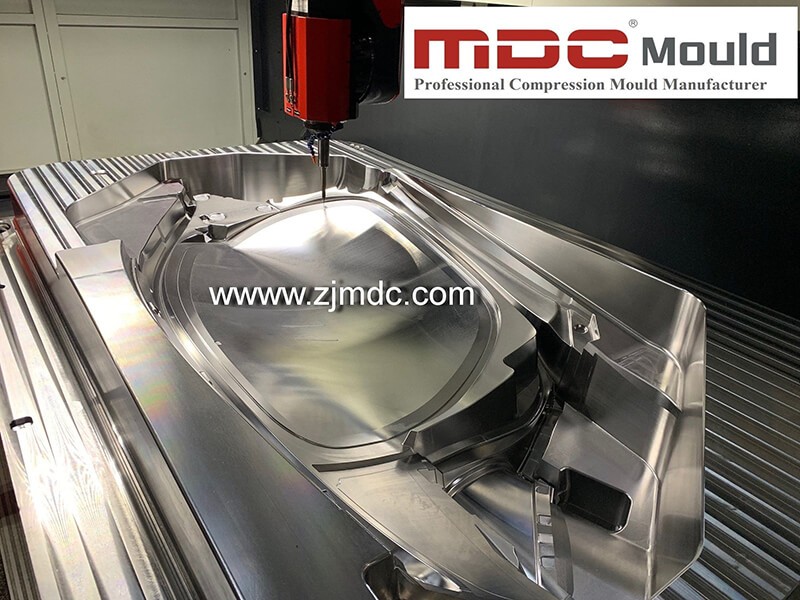
SMC door mold

Engineering Requirements for High-Performance SMC Door Molds

Designing a reliable SMC door mold requires advanced engineering capabilities:

  • Precision cavity design for accurate panel fit
  • Optimized heating systems for uniform temperature distribution
  • Advanced venting design to prevent defects
  • High-quality mold materials for durability and long service life
  • Surface polishing for Class A finish requirements

These factors ensure stable production and high-quality output in automotive applications.

Applications in Automotive Manufacturing

Passenger Vehicles

  • Exterior door panels
  • Inner structural door components
  • Reinforced composite modules

Electric Vehicles (EVs)

  • Lightweight door systems
  • Integrated structural panels
  • Energy-efficient body components

Commercial Vehicles

  • Truck and bus door panels
  • Heavy-duty composite enclosures

The versatility of SMC door molds makes them essential in modern vehicle manufacturing.

SMC vs Metal Door Manufacturing

FeatureSMC Door MoldMetal Stamping
WeightLightweightHeavy
Corrosion ResistanceExcellentRequires coating
Design FlexibilityHighLimited
Surface FinishClass A possibleSecondary processing required
Production EfficiencyHighComplex process

MDC Mould: Professional SMC Door Mold Manufacturer

MDC Mould is a leading manufacturer specializing in high-precision SMC compression molds for automotive applications.

  • Expertise in automotive composite tooling
  • Advanced CNC machining and mold engineering
  • Customized solutions for OEM and Tier 1 suppliers
  • Stable mass production performance

Our SMC door molds are designed to meet the highest standards of quality, durability, and efficiency in global automotive manufacturing.

FAQ: SMC Door Mold and Compression Molding

What is an SMC door mold used for?

An SMC door mold is used to manufacture lightweight composite automotive door panels using compression molding technology.

Why use SMC instead of metal for car doors?

SMC offers lower weight, better corrosion resistance, and greater design flexibility compared to traditional metal materials.

What industries use SMC compression molds?

SMC molds are widely used in automotive, transportation, and industrial equipment manufacturing.

Conclusion

The SMC door mold is a key technology enabling lightweight, high-performance automotive design. With its advantages in durability, efficiency, and flexibility, SMC compression molding is becoming the preferred solution for modern vehicle manufacturing.

By adopting advanced compression molding tooling, manufacturers can achieve superior product quality and maintain competitiveness in the evolving global automotive market.

BMC Mold & Tooling: Solutions for High-Volume Composite Production

MDC Mould specializes in BMC mold, BMC mould, and BMC tooling for high-volume compression molding. Our BMC molding solutions deliver stable quality, long mold life, and efficient composite manufacturing.

As global industries continue to pursue lightweight structures, high mechanical performance, and cost-effective mass production, BMC molding and BMC moulding have become essential composite manufacturing processes. At the core of this technology lies the BMC mold (also known as the BMC mould), together with precision-engineered BMC tooling and BMC tools, which directly determine product quality, production efficiency, and long-term manufacturing stability.

As a professional composite mold manufacturer, Zhejiang MDC Mould focuses on the development and manufacturing of high-performance BMC molds and BMC tooling systems, supporting global customers in achieving reliable and scalable composite production.

bulk-moulding-compound

What Is BMC Molding?

BMC molding is a compression molding process using Bulk Molding Compound, a ready-mixed thermoset composite material consisting of chopped glass fibers, thermosetting resin, fillers, and functional additives. The BMC material is placed into a heated mold cavity and shaped under high pressure, where curing occurs simultaneously.

Compared with other composite processes, BMC moulding offers excellent dimensional stability, short cycle times, and consistent surface quality, making it ideal for high-volume production.

  • Short molding cycles suitable for mass production
  • Excellent surface finish with minimal post-processing
  • Stable mechanical and electrical properties
  • High repeatability and dimensional accuracy
  • Ability to mold complex integrated structures

The Importance of the BMC Mold

The performance of BMC molding depends heavily on the quality and engineering of the BMC mold. During compression molding, the mold must withstand high clamping forces, repeated thermal cycles, and abrasive fiber-filled materials, all while maintaining precise cavity geometry.

A high-quality BMC mould typically includes:

  • High structural rigidity to resist deformation
  • Precision-machined cavities for consistent wall thickness
  • Optimized material flow paths for uniform fiber distribution
  • Effective venting systems to eliminate trapped air
  • Long service life for continuous production environments

BMC Tooling Design and Engineering

BMC tooling design requires deep knowledge of compression molding mechanics, thermoset curing behavior, and fiber flow characteristics. Unlike thermoplastic injection molds, BMC tools must accommodate controlled material flow, pressure balance, and reliable venting.

Key engineering principles for BMC tooling include:

  • Uniform pressure distribution across the mold surface
  • Controlled material flow to prevent fiber segregation
  • Thermal balance for stable and complete curing
  • Reliable sealing to maintain molding pressure
  • Easy demolding to protect both parts and tooling
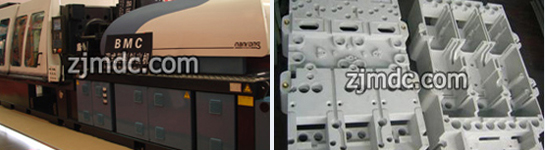
BMC mould
BMC product

Materials and Manufacturing of BMC Molds

BMC molds are typically manufactured from high-grade tool steels or selected aluminum alloys, depending on production volume and application requirements. For high-volume and structural components, steel BMC molds are preferred due to their wear resistance and dimensional stability.

MDC Mould applies advanced manufacturing processes including:

  • High-precision CNC machining
  • Optimized venting and gating design
  • Surface treatments for improved durability
  • Integrated heating systems for stable cycle times
  • Reinforced mold structures for high-tonnage presses

Applications of BMC Molding

Thanks to its balanced mechanical, thermal, and electrical properties, BMC molding is widely used across multiple industries:

  • Automotive structural and functional components
  • Electrical enclosures and insulation parts
  • New energy and EV-related composite housings
  • Industrial equipment covers and supports
  • Construction and infrastructure composite components

Why Choose MDC Mould for BMC Mold Solutions

Zhejiang MDC Mould provides complete BMC moldBMC mould, and BMC tooling solutions, covering design, manufacturing, and production support.

  • Extensive experience in BMC molding and compression tooling
  • Process-oriented mold design for stable mass production
  • Custom BMC tools for complex composite structures
  • Long mold service life with reduced maintenance
  • Technical support from prototyping to serial production

Conclusion

BMC mold and BMC tooling technology plays a critical role in modern composite manufacturing. Through precise engineering, durable materials, and process-optimized design, BMC moulds enable manufacturers to fully realize the advantages of BMC molding and BMC moulding.

Zhejiang MDC Mould remains committed to advancing BMC mold technology, delivering reliable, high-performance tooling solutions for global composite manufacturers.

How Composite Materials Extend EV Range Through Lightweighting

Advanced composite molding technologies such as SMC, BMC, and compression molding significantly reduce vehicle weight, improve energy efficiency, and extend EV driving range.

Under the rapid expansion of the global new energy vehicle (NEV) industry and the implementation of carbon neutrality and carbon peaking strategies, improving energy efficiency and driving range has become a core objective of automotive manufacturing upgrades.

Industry data shows that every 10% reduction in vehicle weight can reduce fuel consumption of internal combustion vehicles by 6–8%, while increasing electric vehicle driving range by 5–10%. As a result, automotive lightweighting has become a critical technical pathway to balance performance, efficiency, and sustainability.

Composite Materials as the Foundation of Automotive Lightweighting

Advanced composite materials are increasingly replacing traditional metallic materials due to their unique combination of high specific strengthlow density, and design flexibility.

Common automotive composite materials include carbon fiber reinforced polymers (CFRP)glass fiber reinforced plastics (GFRP), and basalt fiber reinforced composites.

Compared with steel and aluminum alloys, composite materials typically offer:

  • Density only one-quarter to one-third of steel
  • Specific strength 3–6 times higher than conventional metals
  • Component weight reduction of 30–60%
  • Overall vehicle mass reduction of 10–30%

In addition to weight reduction, composites provide excellent corrosion resistance, fatigue performance, vibration damping, and noise reduction, significantly lowering long-term maintenance costs.

Composite Materials EV

Lightweight Composite Applications in Vehicle Body Structures

In modern vehicle body design, composite materials are widely used in body frames, doors, hoods, tailgates, and roof structures. Through integrated molding processes, CFRP and GFRP components can achieve weight reductions of 35–50%.

Composite body structures also enable optimized aerodynamic designs, reducing driving resistance and improving overall energy efficiency. In several new energy vehicle platforms, the adoption of composite body structures has resulted in double-digit improvements in driving range.

Chassis and Powertrain Lightweighting with Composite Molding

Composite materials play a critical role in chassis and powertrain systems, particularly in suspension components, drive shafts, and structural reinforcements. Reducing unsprung mass improves vehicle handling, ride comfort, and energy utilization.

Carbon fiber composite drive shafts can reduce weight by more than 40% compared with steel alternatives, while improving power transmission efficiency by 5–8%.

For electric vehicles, EV battery enclosures represent one of the most important lightweighting targets. GFRP composite battery housings offer:

  • More than 50% weight reduction compared with steel enclosures
  • Excellent fire resistance and impact protection
  • Superior water sealing and corrosion resistance

These composite solutions directly contribute to lower vehicle energy consumption and extended driving range.

Interior System Lightweighting and Functional Integration

Lightweight composite materials are increasingly applied to interior components such as seat frames, instrument panel carriers, and door inner panels. Typical weight reductions range from 25–40%.

Composite seat frames can be up to 50% lighter than steel frames, improving space utilization and vehicle packaging efficiency. Glass fiber reinforced thermoplastic instrument panel carriers also provide improved acoustic performance and vibration damping.

Composite Materials EV

Advanced Composite Manufacturing and Tooling Technologies

Continuous innovation in materials and processes is accelerating the large-scale adoption of composites in automotive manufacturing.

Key composite molding technologies include:

  • SMC and BMC compression molding
  • High-pressure resin transfer molding (HP-RTM)
  • Automated fiber placement (AFP)
  • Advanced composite tooling and press mold systems

These technologies enable stable quality, high production efficiency, and cost-effective mass manufacturing for global automotive platforms.

Sustainability and the Future of Automotive Composites

Automotive lightweighting is closely linked to sustainability. Lighter vehicles consume less energy throughout their lifecycle, contributing to lower emissions and reduced environmental impact.

Emerging trends such as recyclable composites, bio-based resin systems, and digital process monitoring are further enhancing the sustainability of composite automotive manufacturing.

Conclusion

Composite materials have become the core enabler of automotive lightweighting, directly supporting energy efficiency improvements and extended driving range for both conventional and electric vehicles.

With continuous advances in composite molding technologiescompression molding tooling, and automotive composite applications, the automotive industry is accelerating toward lighter, more efficient, and more sustainable vehicle architectures.